
With his last two films, 2021’s Card Counter and, especially, 2017’s First Reformed, Paul Schrader fought his way to a late-career resurgence, using ideas of faith and redemption to tackle 21st Century sins through his trademark Lonely Man. Master Gardener wastes no time in letting you know you’re in for something similar as we meet Schrader’s latest protagonist Narvel Roth (Joel Edgerton). Of course, he’s alone at night, writing in a journal and ruminating on heavy issues – in this case how gardening is an expression of faith in the future. It’s all familiar stuff and, though there are still flashes of brilliance in Master Gardener, this familiarity does contribute to the closing chapter of this sort-of trilogy being the weakest.
The amusingly-named Narvel works as the head gardener at a grand plantation-era home in Louisiana, keeping the extensive gardens beautifully managed for his capricious employer, the aristocratic lady of the house Norma Haverhill (Sigourney Weaver, imperious), who also calls on him to help plan her social occasions and for the occasional tryst. Narvel, for his part, finds meaning in the work and all the rules he has to obey – his past as a neo-Nazi hitman turned federal informant means he needs a haven, and his live-in gardener’s cabin on Norma’s grounds is exactly that.
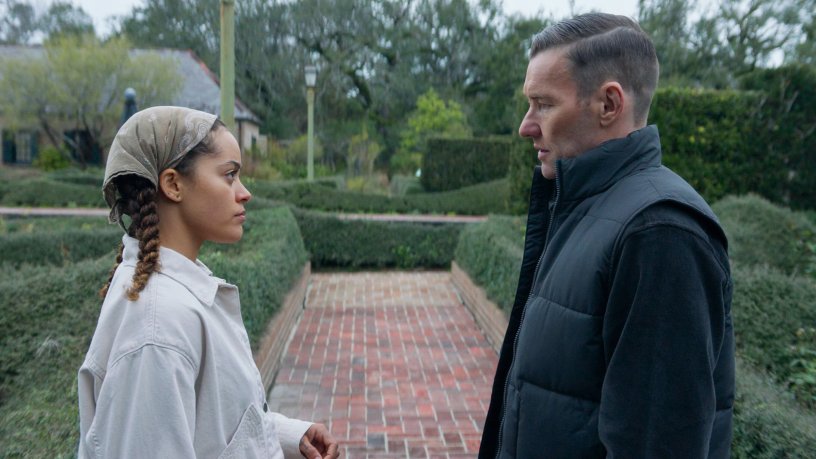
His carefully managed existence is upended, though, by the arrival of Norma’s troubled grandniece Maya (Quintessa Swindell). Recently orphaned and struggling with addiction, Maya is assigned as Narvel’s apprentice and proves a quick and willing study, but a mutual attraction between her and Narvel and her as-yet-unbroken connection to the local petty crime underworld start to reawaken Narvel’s own past troubles. Edgerton makes for a good stoic Schrader lead, slowly allowing Narvel to come out of his shell as Maya’s less deferential presence allows him to bend the rules, and there are moments of genuinely felt connection between this lead couple.
It’s a romance that reaches its apex in Master Gardener’s ‘moment of transcendence’, which is as beautiful here as it was in the two previous films. Reminiscent of the flight over earth in First Reformed and the garden of lights in Card Counter, here the open road ahead of Narvel’s car suddenly flourishes into bloom, until every inch of the screen that isn’t taken up by the night sky is covered in flowers. It’s transporting stuff, crystalising all of Schrader’s thematic concerns into one moment of visual and spiritual optimism, all powered by love.
What’s less convincing is this version of the ‘attempted redemption’ story. While First Reform’s desperate scream at apocalyptic climate change and Card Counter’s horrifying moments of Iraq War torture hit like a gutpunch, the Nazi stuff here feels lightly handled by comparison. The flashbacks don’t give us enough new information of characterisation to grapple on to, and Schrader is largely disinterested in really plumbing the thematic depths of a romance between a reformed white supremacist and a significantly younger biracial woman, all taking place in a compound that can’t help but drum up hints of a slave-state past.
Given how clear-eyed he was on climate and Iraq, that Schrader suddenly wants to tell a less ‘political’ redemption story as relates to someone formerly buying into (and killing for) an ideology of pure hate is odd, even offputting at isolated points. It’s not to say that Master Gardener is a film in particularly poor taste, but without the fearsomely directed rage of its predecessors, it inevitably feels like their lesser sibling.
 Jack Blackwell – Film Reviews