
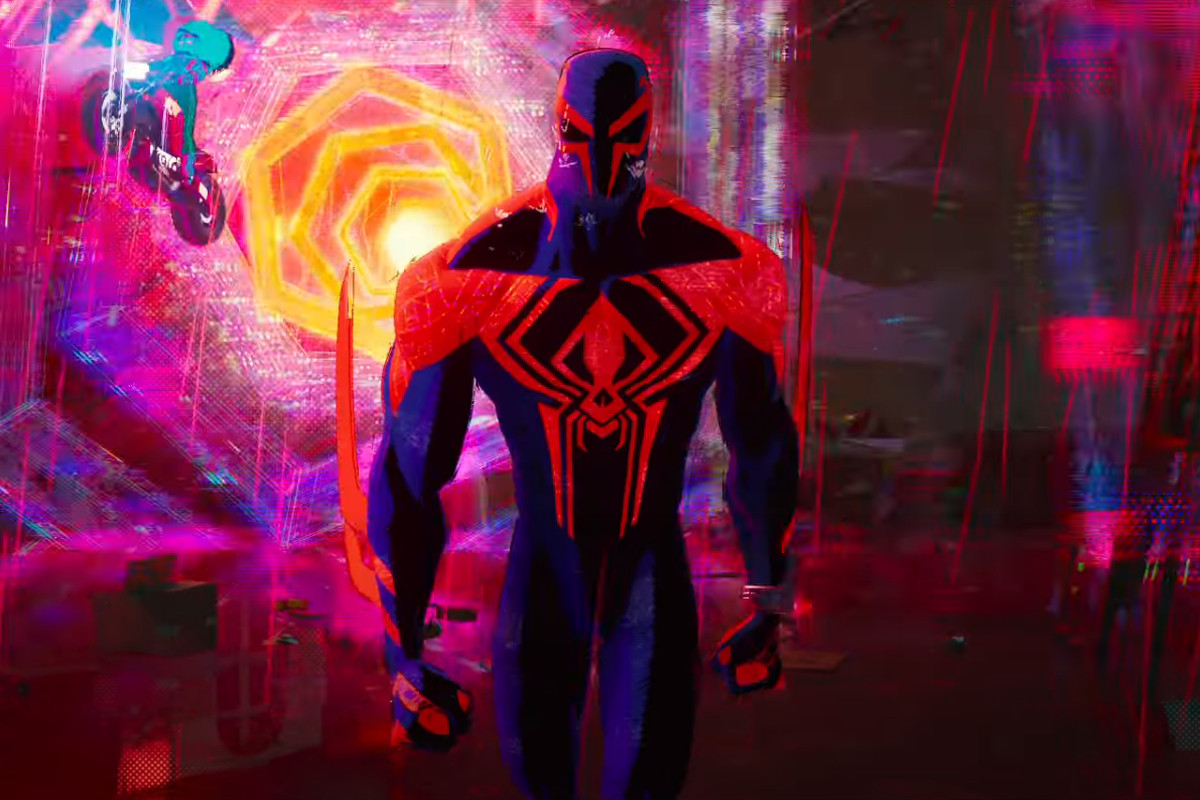
In the not-quite-five years since they became the plot-device-du-jour for everything from superhero franchises to Best Picture-winning dramedies, multiverses have already become a bit stale, their use (especially in the MCU) generally removing stakes from otherwise decent stories – if infinite anythings can happen, why do any of them really matter? Thankfully, the sequel to the film that kicked the trend off is here to teach everyone else, just as Into the Spider-Verse did back in 2018, how to actually *handle* a multiversal story – with bags of heart and a simply mindblowing amount of visual invention. Across the Spider-Verse’s animation hits a level of imagination that is vanishingly rare in blockbuster entertainment, elevating the film even when its story occasionally stumbles.
Following on a couple of years after Miles Morales (Shameik Moore) and his gang of six different Spideys saved the multiverse, he’s still finding the balance between his hero work and his ‘real’ life, missing key moments with his loving parents as he bounces from emergency to emergency. It comes to a head when he encounters the initially goofy villain The Spot (Jason Schwartzman), whose unpredictable portal powers keep growing in size until he poses a genuine threat to multiversal reality. Miles’s failures to adequately deal with The Spot bring him into the orbit of a multidimensional Spider-team headed up by the futuristic and humourless Spider-Man 2099 (Oscar Isaac), who wants to keep Miles contained until they can fix his reality.
It, of course, gets much more complicated than that as dozens of Spider-beings get involved, including a lot of returning faces, and Lord and Miller’s script, written alongside Dave Callaham, does a mostly sublime job of keeping all these ins and outs clear, as well as often very funny. It’s only as we approach the finale that things get less stellar – Across the Spider-Verse is explicitly a part one of two (Beyond the Spider-Verse should arrive next March), and the note it closes out on is kinda unsatisfying.
It’s hardly the first blockbuster to spend a lot of time doing set-up work, but the gold standards like, say, the second Lord of the Rings or Denis Villeneuve’s Dune Part 1 managed to also feel pretty complete within themselves. Across the Spider-Verse doesn’t and the third act, for all of its cool reveals and intense action, suffers for it. Don’t get me wrong, I’ll be counting the days until March 29 2024, but I’d have liked just a bit more resolution than we get here.
But enough about the words; Across the Spider-Verse is a visual showcase first, and here it delivers like a dozen animated Christmases all at once. The joy of movement and seamless blending of comic-book and movie that made the first one an instant industry-changer is retained, while the trio of directors (Joaquim Dos Santos, Kemp Powers, and Justin K Thompson) introduce new idea after new idea until your eyes and mind are overloaded. An early jaunt to Gwen’s (Hailee Steinfeld) universe is just stunning, the beautiful watercolour backgrounds bleeding different colours to match Gwen’s emotions while a trip to Indian comics-inspired Mumbattan is all perfectly choreographed chaos, excellently scored by Daniel Pemberton.
The licensed tracks that helped make Into the Spider-Verse such a lasting cultural force are definitely less impressive and integral this time out; Pemberton mostly succeeds at picking up that slack, but you do miss having a singular moment like Into the Spider-Verse’s ‘What’s Up Danger’ scene. Mostly, though, you’ll be too busy marvelling at just how much is going on on screen at any given moment. They’ve packed so many new Spiders into this film that you’ll hardly know where to look, from the brilliantly bizarre like a Spider T-Rex or sentient vehicle Peter ParkedCar, to instant favourite new character Hobie Brown (Daniel Kaluuya), aka Spider-Punk.
Kaluuya brings an infectious rebel energy to every scene he’s a part of and the voice acting across the board is, again, great, from Moore and Steinfeld to newbies like Isaac and Karan Soni as the boundlessly charming Indian Spider-Man. There are plenty of cameos to catch (this’ll be just huge on Twitter once you can pause it when it hits home release), though the film is mostly effective at not letting this bevy of references bury the more grounded emotional stuff.
At its core, Across the Spider-Verse is again a story about what ‘Spider-Man’ means, both to those who wear the mask and to the audiences that have been consuming this character’s stories for 60 years. It’s an emotionally resonant treatise, even if you do feel the demands of The Franchise pulling on its neck in the third act, backed up by some of the most energetic animation put out by Hollywood since, well, the last one.
 Jack Blackwell – Film Reviews