From Saint Maud to Aftersun to Rye Lane, the last few years have seen a heartening boom in exciting and distinctive debut movies from new British talent. Happily, that trend continues with Dionne Edwards’s Pretty Red Dress, a stylish look at Black masculinity, sexuality, and gender norms that balances a witty warmth with something more confrontational as it examines how families can act as a repressive microcosm of a heteronormative society without even realising it. It’s a fantastic calling card for Edwards and her cast, full of bright colours and big feelings and avoiding ‘kitchen sink’ tropes whenever it can.
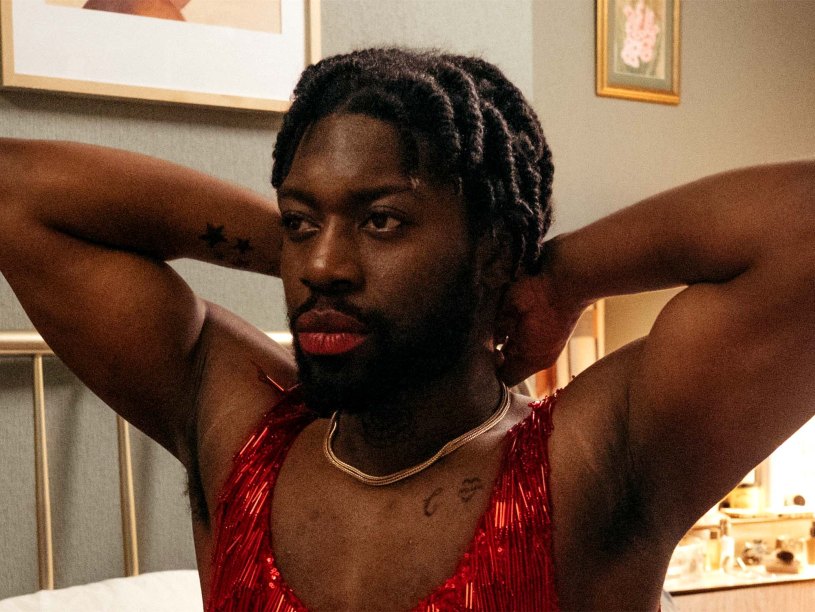
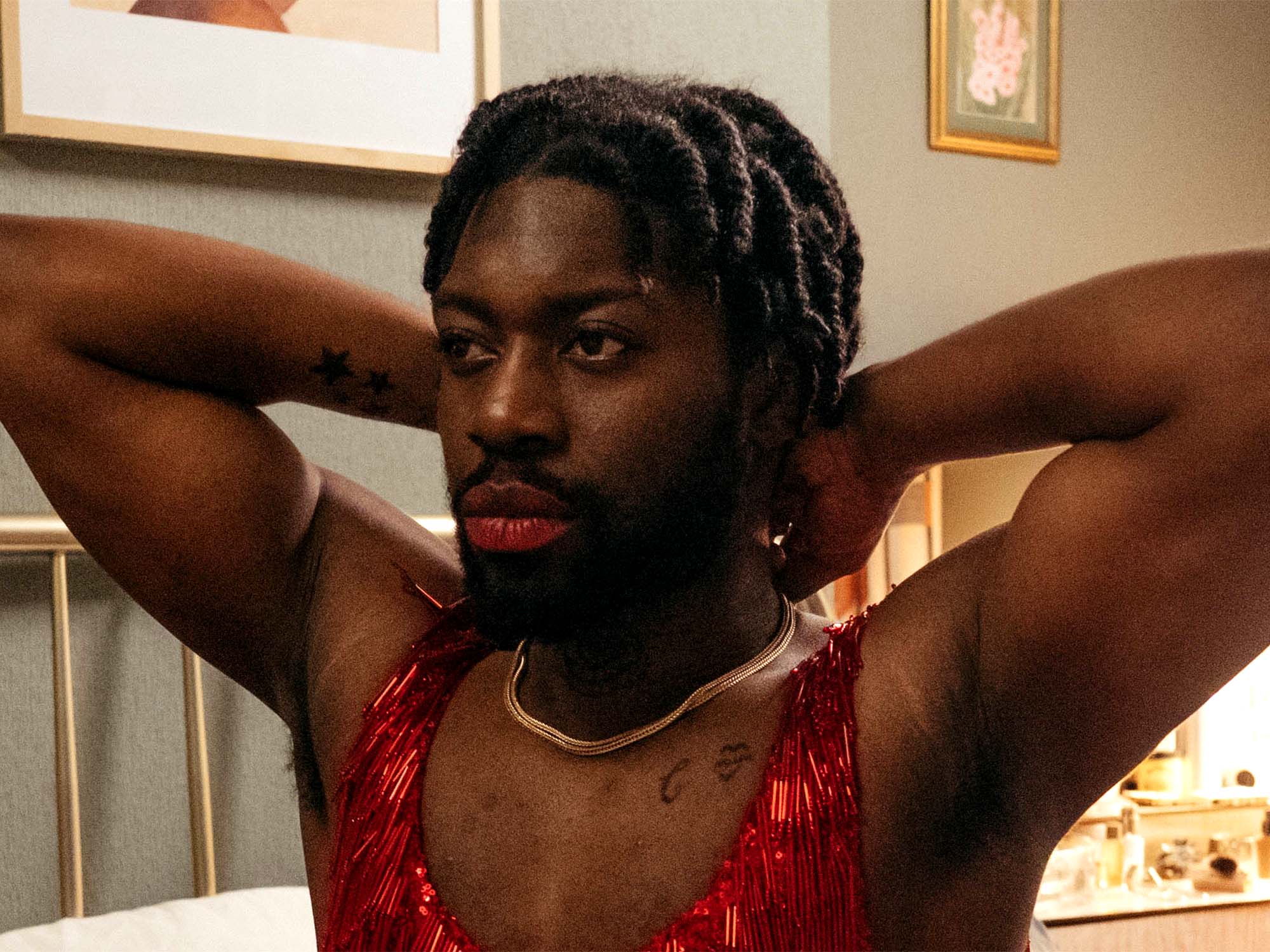
Though it does give a lot of screentime to his partner Candice (singer Alexandra Burke in her first acting role), Pretty Red Dress mostly follows Travis (Natey Jones), a South London man fresh out of a year’s stint in prison whose return home is complicated by his complex relationship with his own masculinity. This is exacerbated by the purchase of the eponymous red dress – bought ostensibly to help Candice get into character for an audition to play Tina Turner in a West End musical – which captures Travis’s imagination. Sat at home while Candice works and their daughter Kenisha (Temilola Olatunbosun) goes to school, he tries the dress on, and is soon accenting it with Candice’s make-up and underwear.
Even if the other characters lack a nuanced understanding of what Travis is going through, Edwards never spins Pretty Red Dress as an explicitly LGBT story – Travis is a straight, cis man who just so happens to be, in the words of Kenisha, a bit ‘off key’. The tension and self-recrimination whenever Travis dresses up is very well played by Jones – the scene in which Candice first discovers him doing it and he tries to spin several equally unconvincing lies at once is gripping.
Jones and Burke, boldly jumping into a role that is sometimes really rather unsympathetic, are both excellent, battling internal anxieties and external humiliations (Travis’s resentment of his more successful older brother feels painfully real), and Olatunbosun impresses too, carrying a very different energy depending on if she’s sharing a scene with Jones or Burke. Kenisha is struggling to fit into her socially-defined box as well, disinterested in the overtly feminine stuff her mum likes and styling herself more like her dad. Travis and Kenisha’s relationship, built on a mutual adoration, is incredibly sweet despite a couple of quietly devastating moments, eventually forming the beating heart of Pretty Red Dress.
Though the stuff around identity is mostly expertly handled by Edwards, there is a scene towards the end where the film seems to lose faith in its audience a bit, suddenly spelling out its themes overly obviously, and the final third is Pretty Red Dress’s weakest area. It’s not that it’s *bad* in any particular way, but there are a few sequences that feel like natural conclusions that then just roll into more story, making the last act feel a bit lumpy and overlong.
Thankfully, the performances and Edwards’s sense of style are more than enough to overcome these quibbles. Naturally, the flashiest stuff comes during Candice’s musical numbers (it’s impressive how much Tina Turner music a British indie was seemingly able to afford), as she imagines the glitz of being up on a major stage, but there’s a dreamlike, almost fantastical, score and colour grade throughout. It’s almost like we get to share these characters’ daydreams, Edwards putting us into their heads to craft a rare intimacy between us and this family unit. I don’t know exactly what creative spark is currently doing the rounds in the water in the UK cinematic scene, but long may it continue.
 Jack Blackwell – Film Reviews