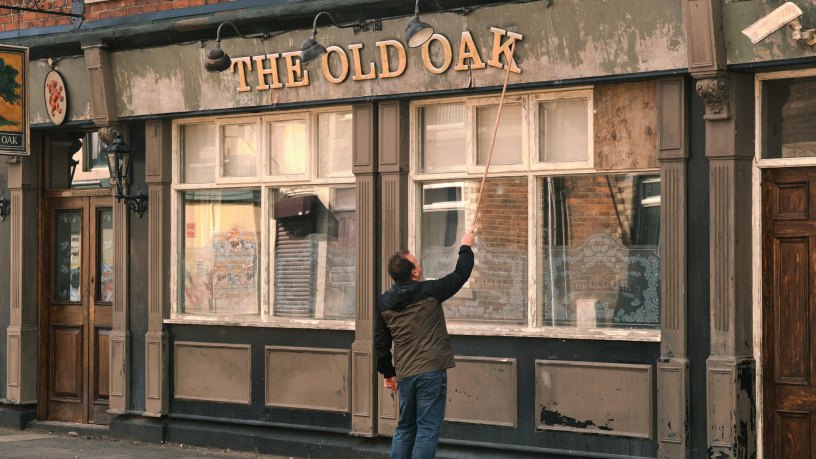

The calamitous last decade-and-a-half of Tory rule has proven a fruitful period for Ken Loach, his fired-up humanism serving as a perfect counterweight to the dull sadism of the Conservative government. Winning the Palme d’Or in 2016 for his look at the benefits system in I Daniel Blake and making (at least in my opinion) his best film of his 21st Century output in 2019 with gig-work drama Sorry We Missed You, he’s been on a hot streak. It’s a run of form that sadly comes to an end with The Old Oak, a profoundly clunky look at Syrian refugees housed in dilapidated northern towns, a disappointment made all the more stinging by the fact that The Old Oak is likely to be the 87 year old Loach’s final film.
Set, pointedly, in 2016 in an unnamed village that never recovered from the closing of the local coal mine, The Old Oak is primarily concerned with the precarity of solidarity, as the already resource-deprived locals take out their frustrations on the recently-arrived Syrian migrants, fleeing the warzone that their home has become. Standing as a sort-of ambassador is the owner of the local pub – The Old Oak – Tommy Joe Ballantyne (Dave Turner), much more empathetic to the plight of the new residents than his peers and helping out with volunteer work where he can.
In tackling the twin crises of both regional deprivation in the UK and the plight of refugees, The Old Oak (once again written by Loach’s regular collaborator Paul Laverty)lacks the sharp focus that made I Daniel Blake and, especially, Sorry We Missed You, so devastating, its broader brush painting some very two-dimensional characters. Even Tommy Joe (aka TJ) and co-lead Yara (Ebla Mari), a Syrian photographer, feel a bit more like Loach-by-numbers characters than real people, and the problem is exponentially more pronounced with the supporting cast, who are a collection of (mostly quite badly acted) racist cliches. Loach oftentimes has a gift with his non-professional cast members, but his magic hasn’t quite worked here.
The dialogue here sounds like Dialogue, instead of people actually talking to each other, Loach and Laverty resorting too often to big, didactic speeches without letting us get to know the people making them. Misery is piled on misery (watch out for the scene in which a cute little dog gets mauled to death) almost self-parodically, at least until an incongruously jolly ending which feels entirely at odds with the predictable bleakness that has preceded it.
There are a few moments in which Loach lets the characters actually speak for themselves, and The Old Oak shines much brighter whenever that happens, but they’re too few and far between. It’s not the kind of misfire that will have any sort of negative effect on Loach’s legacy – his place as one of the UK’s most distinctive and important filmmakers has been long assured, and The Old Oak is, admittedly, Loach to a T – but, if this is to be farewell, you can’t help but wish for a more forceful goodbye.
 Jack Blackwell – Film Reviews