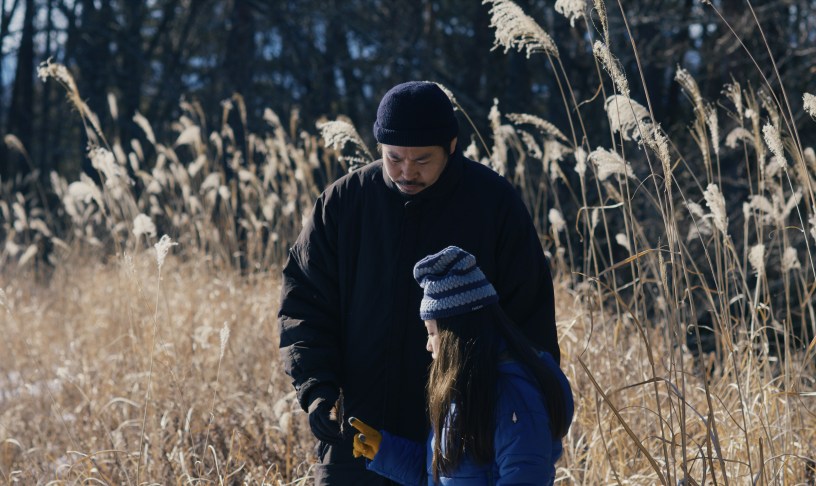

If the title of Evil Does Not Exist, the latest from Drive My Car director Ryusuke Hamaguchi, suggests a certainty about the moral structure of the world, rest assured that it’s the kind of title with an unwritten ellipsis attached to it. In this beguiling, poetic, and ultimately just haunting tale of conservation and cruelty in rural Japan, evil might not exist, but property developers and quick-buck-chasing consultants do, and that’s pretty much the same thing, Hamaguchi diagnosing ills in the modern world without providing easy answers or even, really, simple questions.
In the relatively unspoiled countryside around Tokyo, we find our hero Takumi (Hitoshi Omika), single father to young, nature-loving daughter Hana (Ryo Nishikawa) and the odd-jobs guy for his local village, whether that’s fetching fresh glacier water for the local udon noodle restaurant or simply chopping firewood. Hamaguchi presents Takumi’s day-to-day in long, mesmerising takes, finding pleasure and purpose in the simple acts of work that fill Takumi’s hours. It’s a harmonious existence that is threatened by a company that, seeking to cash in on the Japanese government’s post-COVID development stipends, wants to build a ‘glamping’ (Hamaguchi’s script gets a lot of mileage out of just how stupid-sounding a word this is) retreat next to the village to offer an ‘authentic’ rural getaway to wealthy Tokyo residents.
With their minds already made up, the firm sends two representatives – older man Takahashi (Ryuji Kosaka) and younger woman Mayuzumi (Ayaka Shibutani) – to conduct a town hall with the locals to collect their grievances and then, presumably, chuck them in the bin and continue on anyway. Yet, Takahashi and Mayuzumi find themselves embarrassed and even ashamed at being the face of this project, especially as the villagers cite their very valid concerns about the campsite starting fires and its associated septic tank poisoning their beautifully clear water, and it starts to look as though they might defect.
What follows is a rather opaque story that moves in directions that make more sense emotionally and poetically than they do literally, and the result is absolutely captivating. Nature itself seems to start to stir, though for what reason, and to whose benefit, is unclear. Hamaguchi tells much of his story without words, from the initially mundane-looking yet laser-precise costuming to the shiveringly wintry surroundings that seem to constantly echo back the sounds of human interference.
There’s a chilling dark heart to Evil Does Not Exist, but hope too, even in the bleak finale as an incoming mist heralds doom. Within its unhurried rhythms (though, at a ‘mere’ 106 minutes, this is a short film as far as Hamaguchis go) lies a completely earnest respect for the power of community, neighbours who will go above and beyond for one another without hesitation. Unfolding like a mythic parable, it’s hard to adequately articulate exactly the feeling that Evil Does Not Exist leaves you with, but one thing is for certain; it burrows right down to your bones.
 Jack Blackwell – Film Reviews