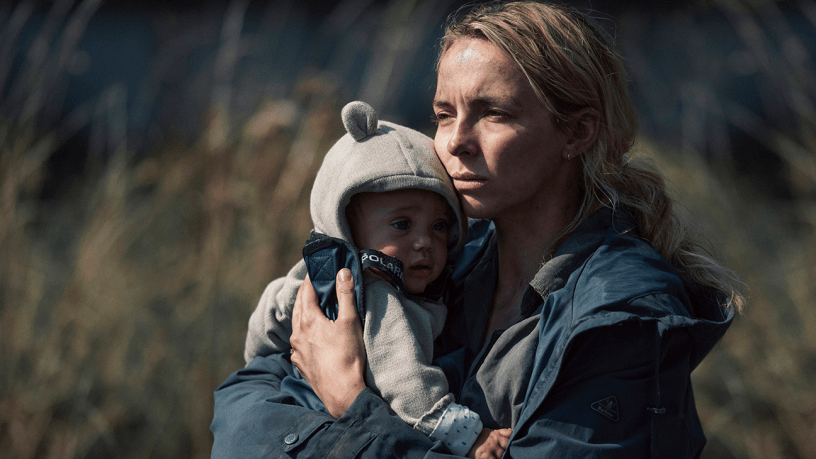

After her sterling, star-making work in TV and theatre, as well as being first among equals in the starry ensembles of The Last Duel and The Bikeriders, Jodie Comer finally graduates to her first undisputed movie lead role in climate-apocalypse drama The End We Start From and, as you might expect, it’s a promotion she takes to with gusto. As a woman with a newborn baby navigating a flooded England, she’s in every frame of the thing, her typically fearless performance elevating what is otherwise a slightly too low-energy version of the end of the world.
As with all the other figures in the film, adapted by first-time director Mahalia Belo and screenwriter Alice Birch (who wrote last year’s sublime adaptation of The Wonder) from Megan Hunter’s novel, Comer’s character, labelled simply ‘Mother’ in the credits, goes unnamed throughout as she trudges from disaster zone to disaster zone. In an all-too plausible apocalypse, this not-even-future version of the UK has been hit by relentless rainstorms, submerging major cities and low-lying villages, and it’s in the escape from London in the first act that The End We Start From is at its strongest.
The ever-increasing panic as the full scale of the devastation becomes evident, made all the more desperate by the fact that the Mother has just gone into labour as her home is drowned, is contagious, providing an urgency that helps propel the rest of the story even as the pace gradually slows to a crawl in the later moments. Comer is fantastic here, and throughout, balancing terror with resilience, crafting an utterly convincing portrayal of a woman putting on a façade of strength for not just her baby and slightly feeble husband (played by Joel Fry), but her own psyche too. While the inclusion of a helpless infant could feel a bit ‘hat on a hat’ here when the stakes are already high, Belo and Birch avoid cheap threats, while the growth of the child serves as a neat way to mark the passage of time within the story, which happens over months.
It’s in this longer-term plotting that The End We Start From trips up though, with just a few too many sequences of largely incident-free downtime. While it’s nice to have a vision of the apocalypse that isn’t just instant psychos, bandits, and raiders (one of a few touches, the most evident being the focus on the female bodily experience of a crisis, that reflect the production’s mostly female leads), these lulls do somewhat flatten out the drama. When it gets going, especially when we’re introduced to Katherine Waterston as a fellow new mother who becomes a fast friend and traveling companion, The End We Start From actually rather reminded me of a less exciting version of 1917, with a protagonist marching through locales and checkpoints in an almost videogame-y way. Hell, there are even some tiny cameo roles for Mark Strong and Benedict Cumberbatch to further push the comparison.
Belo and Birch do a fine job of drawing out the story’s big ideas (the relationship between motherhood and our conservatorship of nature, the contrast between birth and mass death) without hitting you over the head, and a final message of hope makes for a gently touching ending. Hardly as exciting as a lot of its genre stablemates – it bears a lot of visual similarities to, say, Children of Men but without any of Cuaron’s bravura filmmaking – there’s still a mostly compelling core to The End We Start From, a core provided by a Jodie Comer performance that is surely a herald of a true movie star career to come.
 Jack Blackwell – Film Reviews