Daniel Kaluuya switches roles from in front of to behind the camera with dystopian social drama The Kitchen, a solid if rather unremarkable directorial debut from one of Britain’s finest actors. Co-directing with Kibwe Tavares, not to mention writing the script alongside Joe Murtagh, this is clearly a Kaluuya passion project and at its best in its moments of showing London through Kaluuya’s eyes as a young, socially conscious Black creative (not to mention die-hard Arsenal fan). But, set as it is in a middlingly-built future world, it’s a film of two halves, with its sci-fi elements mostly feeling weak and tacked-on.
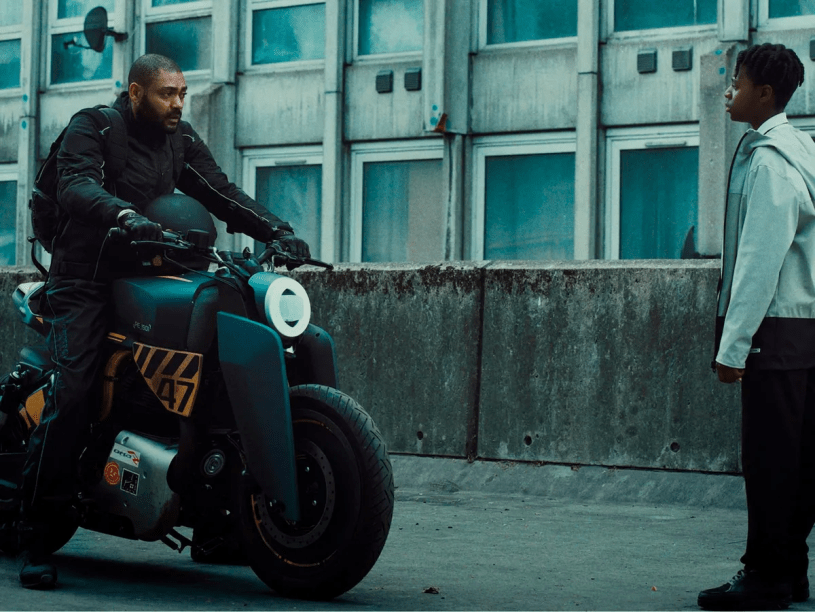
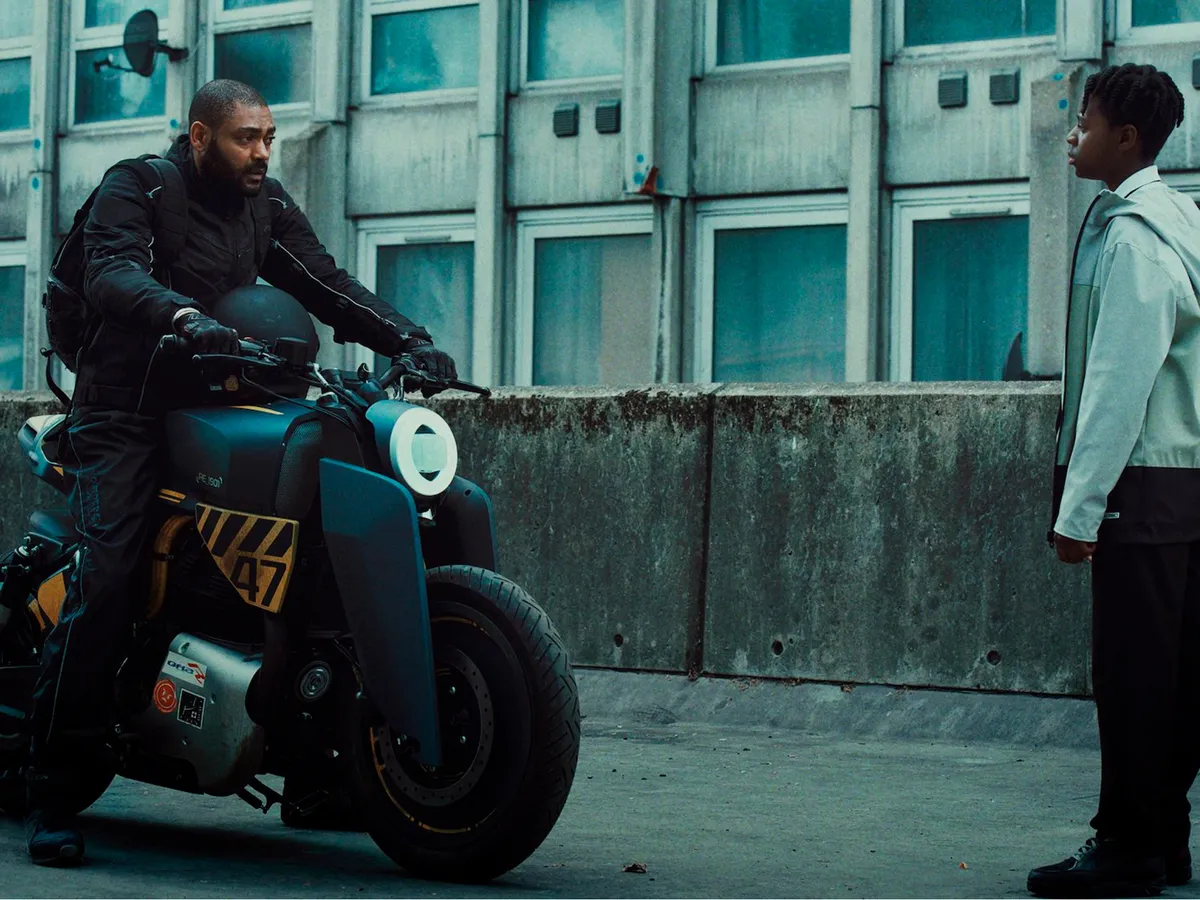
Kaluuya himself never appears as an actor here (and maybe he should have, someone of his calibre I think would have very much elevated The Kitchen), the lead role instead going to rapper and Top Boy star Kano. He plays Isaac, aka Izi, a man living in the eponymous ‘Kitchen’, a sprawling estate that stands as the last publicly-owned residential space in London while the rest of the city has seemingly been entirely taken over by a property company called Buena Vida. In what is probably the film’s most interesting touch, though, Izi has no desire to protect the Kitchen, no pride in its community spirit, and is instead desperate to get on the Buena Vida property ladder.
It’s a refreshingly unsentimental look at the limits of local pride and tradition, although, of course, Izi will eventually be forced to break open his protective shell of cynicism when he encounters Benji (Jedaiah Bannerman), a kid in his early teens who may be Izi’s biological son and becomes a surrogate one regardless. Izi meets Benji after he sees news of Benji’s mother’s untimely death at his job at a futuristic funeral home for the working class, where people without much money have their remains turned to fertiliser for trees in a vaguely defined ecological project.
This is the most potent idea in Kaluuya, Tavares, and Murtagh’s worldbuilding – eventually the families who choose this process won’t even be able to visit their loved ones’ resting places, as there is no way to track where the trees are eventually planted, removing even death as a leveller between rich and poor. Otherwise, though, the world of The Kitchen is pretty a bog-standard dystopia; if Cyberpunk 2077 were to release a UK-set DLC, it would look *exactly* like this.
It means that the sci-fi of it all never feels particularly essential or even that attached to the story at large, which moves quite slowly and struggles to find a focus – though the violent police raids that attempt to disperse the Kitchen’s residents to make way for private development provide reliable shocks of rage. There are some great individual moments, like a genuinely moving song of collective grief at a funeral, and it’s really fun to see Arsenal legend Ian Wright appear in a relatively meaty role as the radio announcer/de facto leader of the Kitchen, but these scenes only loosely cohere into an end result. Some threads even feel unfinished – there’s a subplot about Benji ‘falling in with the wrong crowd’ when he’s taken in by a charismatic rebel (played by Hope Ikpoku Jr) who leads the Kitchen’s more militant youth in various raids on the richer parts of London to secure supplies for the Kitchen, but it doesn’t quite go anywhere satisfying.
A lot of The Kitchen could absolutely take place in modern London, which is certainly part of the point, but it’s a point that leaves the film rather in conflict with itself, doing things in half-measures. If it didn’t have to bother with any sci-fi stuff, it could have dived deeper into its supporting cast – only Izi really feels like a three-dimensional person – while, on the flipside, a fuller commitment to unique worldbuilding might have made the whole endeavour more immersive. As far as actor-turned-director debuts go, it’s ambitious and distinctive enough to be encouraging but, given Kaluuya’s exceptional work under the guidance of filmmakers like Jordan Peele, Steve McQueen, and Denis Villeneuve, it’s hard not to want just a little more heat out of The Kitchen.
 Jack Blackwell – Film Reviews