With his last two films, Silence and The Irishman, Martin Scorsese has settled comfortably into a ‘stately historical epics’ period, and so there couldn’t be a better creative collaborator/provider of source material for where the legendary 80-year-old filmmaker is right now than David Grann. The author of exceedingly well-researched yet still rollicking non-fiction tomes, his book Killers of the Flower Moon has proved such a natural fit for Scorsese’s sensibilities that they’re already planning their next collaboration – an adaptation of Grann’s naval mutiny book The Wager. It’s no surprise that Scorsese wants to get back on the Grann-wagon so soon; his take on Killers of the Flower Moon is yet another late-period masterpiece.
Grann’s book covered one of the first cases to really bring the nascent FBI to national notoriety in the US – the systematic mass murder of the Native Osage peoples of Oklahoma by their greedy white neighbours in the early ‘20s after huge oil reserves were found on Osage land, making their people, for a brief time, the richest per capita group in America. Scorsese and co-writer Eric Roth keep these basic building blocks in place, but push the FBI side of the story to the side, instead focusing on the Osage people and those who did them harm.
Chief among the harm-doers is William ‘King’ Hale (Robert De Niro), a deeply sinister power-broker who acts as a patriarch and ‘friend’ to the Osage (in modern terms, he styles himself as an ‘ally’, going so far as to become fluent in the Osage language) while simultaneously ordering their deaths to ensure their land rights flow in the white direction. His chief lackey in this endeavour is his much dimmer nephew Ernest Burkhart (Leonardo DiCaprio), who is ordered to seduce and marry wealthy Osage woman Mollie (Lily Gladstone) to secure her property in the event of an all-too-predictable ‘untimely demise’.
It’s a story that is both tragic and a capital-T Tragedy, as Mollie’s family starts dying off around her, isolating her until the weaselly Ernest is her only support. With the much-discussed three-and-a-half-hour runtime (long, yes, but you wouldn’t cut a second of it, Thelma Schoonmaker yet again proving that she’s the best editor in the world), Scorsese and Roth have a luxurious amount of space to build Mollie’s world before they destroy it. It makes the inevitability of disaster that much more wrenching and, as Hale’s plans increase in scope and speed, there are moments here that will leave you feeling genuinely sick in the soul.
It’s not an exercise in pure misery, though, Scorsese’s trademark restless energy granting plenty of thrills, whilst there’s also just a simple joy in the care that and his production team have taken with every incidental historical detail they could muster up. The sets and costumes are breathtaking in their beauty and detail, while the mammoth runtime (and huge, Apple-granted budget) allows Scorsese to switch genres every now and then, keeping things consistently gripping. When the FBI, led by Agent Tom White (Jesse Plemons), first arrive, for example, this Shakespearean take on one of America’s (many) original sins is able to become The Untouchables for half an hour and it’s an absolute blast.
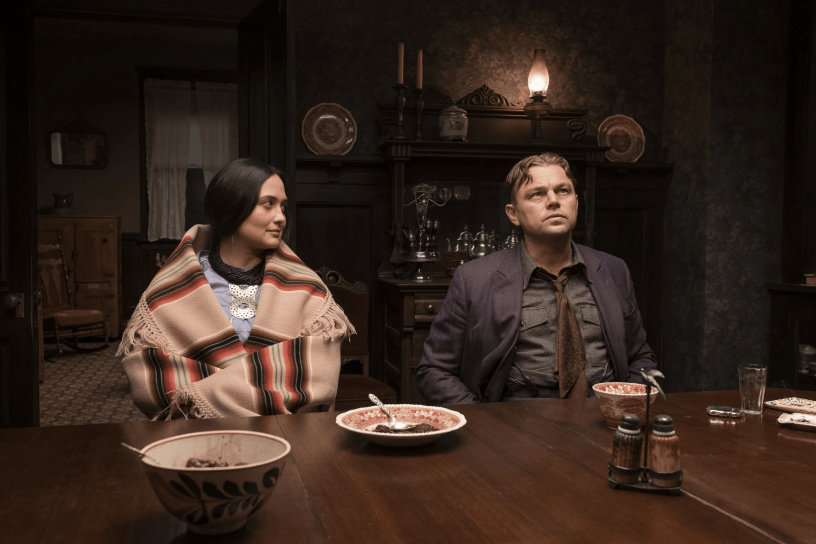
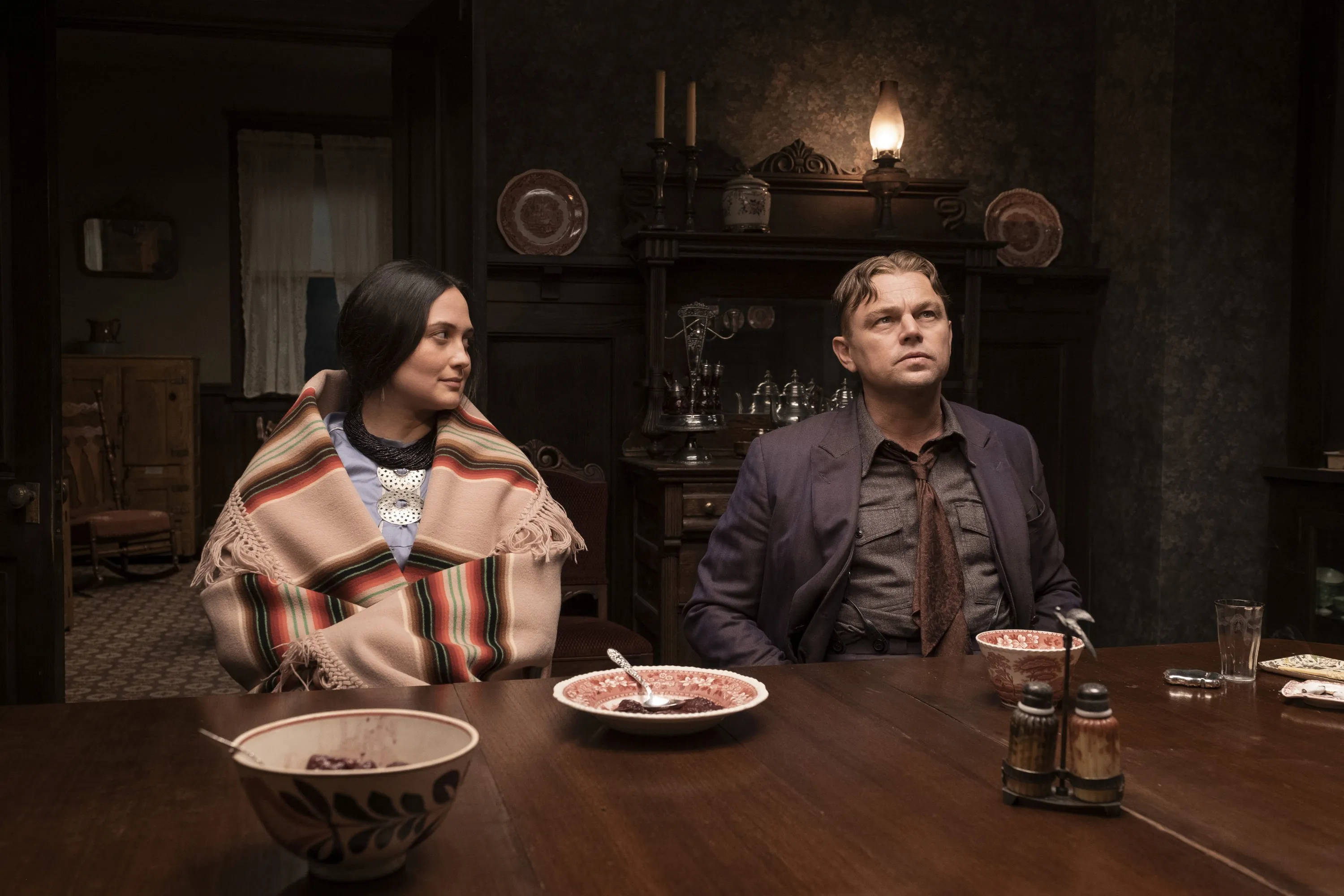
At the beating heart of Killers of the Flower Moon lies the relationship between Mollie and Ernest (who, in a poke in the eye to nominative determinism, is almost allergic to sincerity), which becomes, despite everything around it, movingly real. Ernest doesn’t really have a redeeming feature, but there’s something honest at the core of his marriage to Mollie, and he does love the kids he has with her, and Scorsese and Roth mine this complexity superbly with rich dialogue – in both English and Osage – between the pair.
Gladstone is superb in what is easily her biggest role to date, holding her own against legends, whilst DiCaprio shows yet more strings on his bow as modern Hollywood’s most essential *movie star*. Playing against type as an easily-led and uncharismatic coward, he’s just extraordinary in his ability to hold an entire film in his hands as a character that, without his input, would simply fade into a crowd, taking Rick Dalton’s self-pity and Jordan Belfort’s hilarious drunken gurning and affixing them to a slimy pathetic-ness we’ve never seen from him before.
A deep supporting cast made up of a series of simply fantastic *faces* keeps the world vibrantly alive, helped immensely by Scorsese’s refusal to traffic in stereotypes. The Osage community, much like their Black fellow Oklahomans in Tulsa (the massacre of which makes a small but pointed appearance here), were wealthy, modern people, and Scorsese, with the guidance of the community, captures their heyday in all its glories and weird contradictions. Without ever becoming dry, Killers of the Flower Moon is a proper history lesson, and it’s amazing to see a director given this kind of money to take this kind of approach (hopefully, given that they’ve also got Napoleon coming out this year, it’s a trend that Apple TV, as new Hollywood power players, stick to).
A thrilling and moving epic for grown-ups, completed by a truly bravura ending that really drives home how deeply affected Scorsese himself was by this tale, Killers of the Flower Moon will hopefully join the mega-success story of Oppenheimer to prove that these kind of weighty, auteur-driven projects still have mainstream, blockbuster value. Even if it doesn’t, the fact that Scorsese is still able to take swings as big as this as he enters his 80s is just further proof that he may well be the best American to ever step behind the camera, able to put out a film every three or so years that would easily be any other director’s crowning glory. In a heartbreaking recent interview, he said that he may only have one or two films left in him – let us cherish every moment we have left with one of cinema’s true titans.
 Jack Blackwell – Film Reviews
This and The Irishman are two films I am happy to sit through the lengthy runtime of