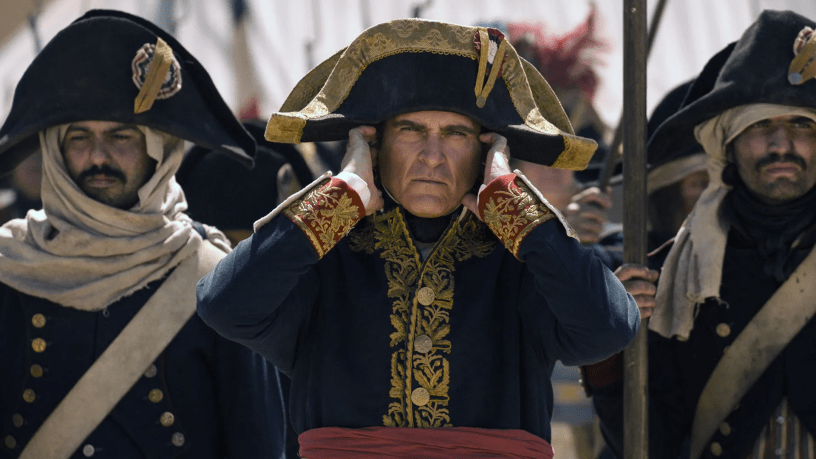
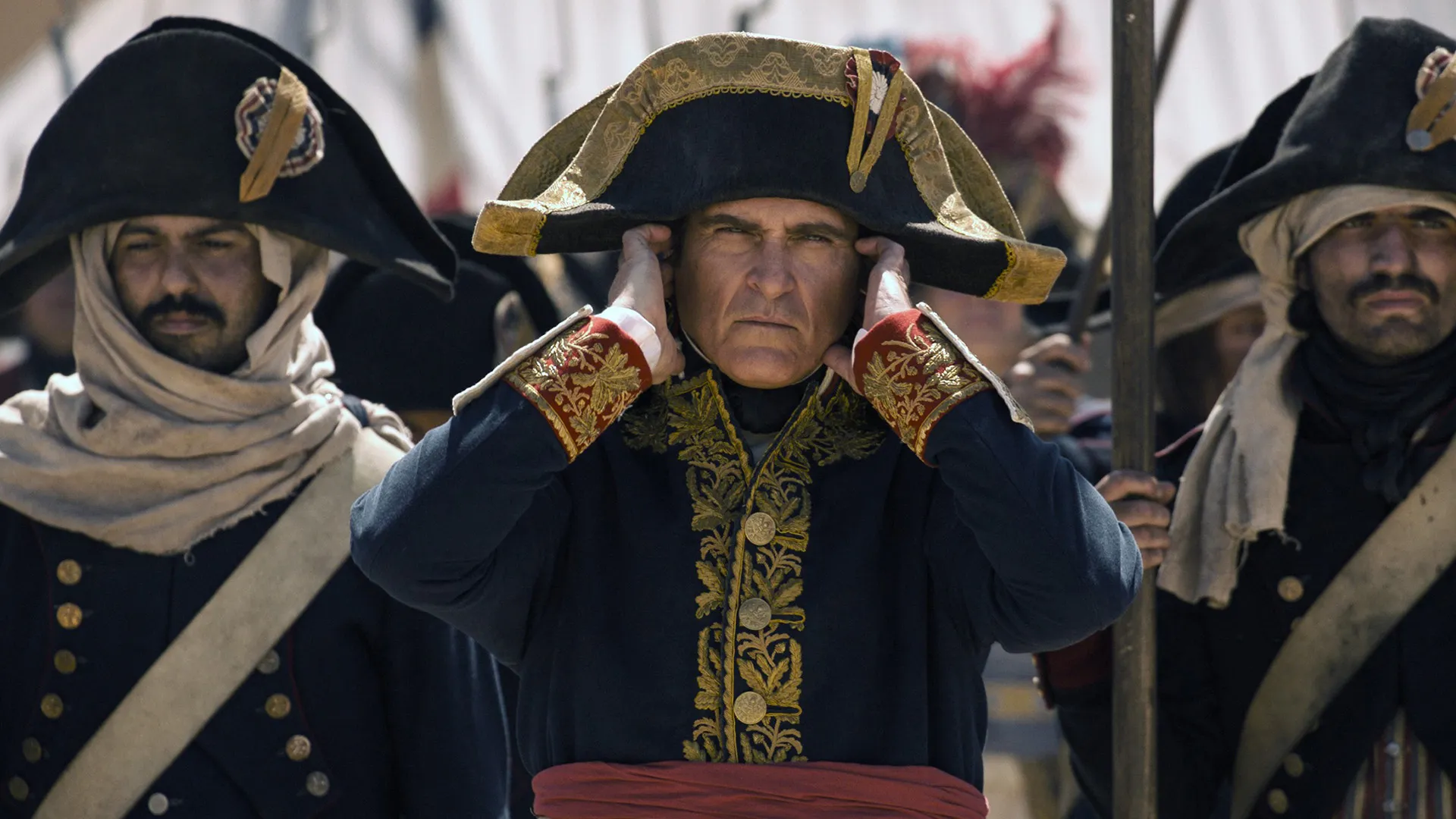
Napoleon Bonaparte has forever been a subject of fascination in cinema, from Abel Gance’s silent 1927 biopic being one of the first true canonical ‘Great’ films, to Sergei Bondarchuk marshalling literal armies for 1970’s Waterloo, to the eternally nagging ‘what if?’ of Stanley Kubrick’s unmade epic. Into this fine tradition enters Ridley Scott with Napoleon, a take on the eternally compelling French dictator that separates itself from the pack by not taking its title character, played by Joaquin Phoenix, all that seriously. Yes, he is of course a master of war here, at the front of the charge for a variety of masterfully marshalled battle scenes, but he’s also a pompous goon whenever he’s not fighting, a balance that isn’t always struck all that successfully, eventually miring the film in a morass of bizarre tone shifts.
Scott’s film, written by David Scarpa, covers almost 30 years in the life of Napoleon, from his initial victories fighting for the French Revolutionary government in 1793, to his coronation as emperor and conquest of Europe, to his eventual downfall in Russia and at Waterloo, up until his death in exile on his prison island of St Helena. It’s a fittingly epic scope for this larger than life figure, and one that allows Scott and Scarpa to keep the pace up even with a nearly 160-minute runtime.
Not as much of that time as you might expect, though, is spent with Napoleon at war. Instead, precedence is often given to Bonaparte’s personal life, most particularly to his relationship with his wife Josephine (Vanessa Kirby), with whom he is passionately, almost humiliatingly in love. It’s here that Scott and Scarpa’s more irreverent instincts kick in, with Napoleon frequently reduced to a belligerently horny weirdo. It’s undeniably funny at points, but rather too much time is spent in this mode and, while a strange and idiosyncratic tone is hardly an inherently bad thing in a historical epic, it eventually starts to undermine everything else.
For one, it’s hard to believe in the central relationship being as world-changingly intense as we’re told it is. Kirby and Phoenix each give solid and fun performances, though Phoenix in particular is hardly matching up to his best work, but Josephine’s domineering presence in Napoleon’s psyche never quite convinces. Part of this, inevitably, is down to Phoenix being much too old for the role he’s playing – Napoleon was in his 20s and 30s for many of his triumphs. Scott’s disregard for historical accuracy is mostly fine, but the wrong-way-round age gap between Phoenix and Kirby (Josephine was actually 6 years Napoleon’s senior) puts the on-screen power balance too squarely in Napoleon’s favour.
Napoleon’s honking peacetime idiocy also creates a strange disconnect between the man we see in private and when politicking, and the man who leads France’s armies into battle, where his unwavering genius strikes terror into opposition nations. Of course, this disparity is part of the point – talent at war is quite different to being conversationally quick or good at sex (at which Scott’s Napoleon is hilariously bad) – but the gulf between the two versions of Napoleon is so vast, with the change often happening so suddenly, that it feels like there are two cuts of the movie fighting against one another.
When the battles can speak for themselves, though, Napoleon soars. Scott has always been one of the premiere ‘grand battle’ directors, and he’s at the top of that particular game here. From a thrilling early night-time siege at Toulon (a masterclass in shooting a low-light action scene in a way that is actually comprehensible) to a ruthless demonstration of tactical mastery at Austerlitz to the thunderous final showdown against the English led by Arthur Wellesley (a small but juicy role for Rupert Everett) at Waterloo, the best of these are up there with the best set-pieces of Scott’s career.
There’s mud and blood, fear and weight, Scott creating order from chaos on the battlefield in much the same way as his protagonist did. Grandiosity is the mode in which Napoleon is most comfortable, with huge sets and lavish costuming making for a satisfyingly tangible recreation of the period; pretty much every location here feels roughly lived-in, even the eerily empty city of Moscow that meets Napoleon after his march through Russia. It would have been nice to see this world through a less murky colour grade, but it does feel a bit churlish to complain about lack of sparkle when Dariusz Wolski’s camerawork is otherwise so ambitious and involving.
Great sound and music complete the immersion – at its best, Napoleon creates a past you can really sink into (fast-forward through the funny sex scenes and this would be a pitch-perfect classroom movie for older history students). I think Scott managed the balance between history and humour much more cleanly in 2021’s The Last Duel, but to have an 85-year-old elder statesman of big-budget directing come out firing with a film with this much irrepressible *swagger* is a heartening thrill all its own.
 Jack Blackwell – Film Reviews
Good review. I felt that this movie was both good and bad, but more on the disappointed side of things. I loved the production quality and the action scenes were meticulously staged and choreographed in a cinematic way, but the movie just felt quite fragmented and disjointed. The story of Napoleon (his life, his rule, his military prowess) deserve an expansive and closer look into it all, but the movie merely glosses over it all in a rather patchwork narrative construction. Phoenix and Kirby (in my opinion) were great casting choices, but I felt that Phoenix’s direction for Napoleon was awkward at times. Yet, Phoenix is the only actor who could achieve such quirks and other mannerisms within such a character role. It’s disappointing to see this film just be “adequate”, especially from such a skilled and acclaimed director such as Ridley Scott