
Zack Snyder’s latest and grandest epic, Rebel Moon, started its life as a pitch for a new Star Wars movie, but when you see the finished product – now set in an original universe and brought to life by Netflix money rather than Disney – it’s swiftly pretty clear why Lucasfilm passed on this particular vision. Not only is Rebel Moon very happy to indulge a sadistic (and rapey) streak that would make any Disney exec balk, it’s also just a mostly dull vision of the galaxy. Sure, there are epic backstories and big laser gun battles and colossal spaceships, but nothing here feels novel or exciting, simply a drab, videogame-y retread of the (generally much better) sci-fi and fantasy works that inspired it.
We start, as any Star Wars rip-off must, on a backwater farming planet, where a possible chosen one, in this case ex-soldier Kora (Sofia Boutella), resides before an encounter with an evil galactic empire forces her to take up arms and become a hero. Thus begins Kora’s interstellar Seven Samurai quest to assemble a force to defend the innocent farmers and strike back, from disgraced ex-general Titus (Djimon Hounsou) to the legally-distinct-from-Han-Solo smuggler Kai (Charlie Hunnam), via lightsaber-wielding warrior woman Nemesis (Doona Bae).
There are a few more as well but, with the exception of Kai, none of these heroes make even the slightest impression. Snyder’s character work has never been his top priority in any of his films but it is particularly dire here, most characters barely even reaching ‘archetypal cypher’ level, instead functioning as walking exposition machines that it’s impossible to feel anything for. This shoddy writing is matched by a series of disinterested-at-best performances, with Boutella in the lead particularly awful. Flat and awkward, she’s a terrible presence on which to place the pressure of shouldering a whole new epic franchise.
Of the protagonist cast, only Hunnam gets away unscathed, bringing an easy charm that shines through even despite his baffling accent work, while Ed Skrein is also good value on the villainous side as preening pervert Atticus Noble, the right-hand-man of the Big Bad, Regent Belisarius (Fra Fee), who only appears briefly to set up the sequel. Due in just four months, this swiftly incoming follow-up explains, but doesn’t excuse, the rushed and incomplete-feeling finale here. It’s an underwhelming ending to a generic story, with a final battle that feels very floaty and inconsequential.
A huge part of the success of the first Star Wars (and Lord of the Rings and Harry Potter, both of which have sequences stolen pretty much wholesale by Rebel Moon) was that its world, no matter how ridiculous, felt lived-in, with real, grubby-looking locations and clear cinematography that gave you a good idea of a place’s geography. Snyder’s aesthetic is, inherently, anathema to that, the slow-mo and deliberately fascistic visuals he’s drawn to making the details of any individual place or person abstract and impossible to really *feel*. Action scenes lack punch too – there’s none of say, 300’s, kinetic energy here.
Though there are some moments of impressive scope, there were just as many times during Rebel Moon where I was wondering ‘is it meant to look like that?’. This is, to put it plainly, an ugly film, mostly thanks to consistently hideous lighting that makes everything a chore to look at. It’s a shame, because Snyder has some interesting design ideas here – even if one of the monsters is ripped directly off of a Dark Souls boss. Different planets have distinct aesthetics, from the Viking-inspired names and beards of the initial farming planet to the Nazi-Roman vibes of the Imperium, while there are some enjoyably gross and weird aliens.
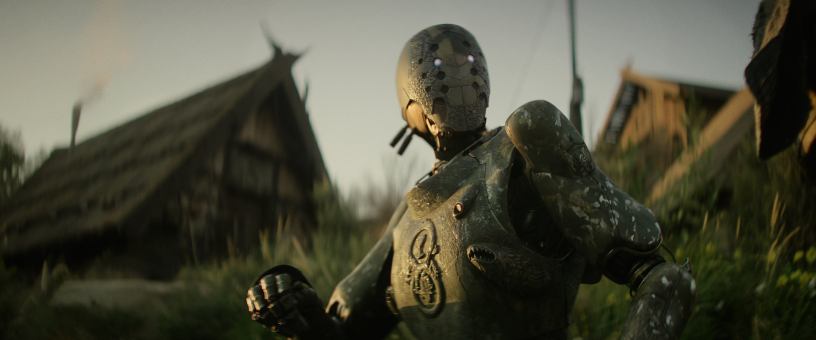
More so than some of the actual videogame adaptations this year, Rebel Moon ultimately feels like a videogame that became a movie kind of by accident. There are companion-recruiting side quests, some simple worldbuilding, a few boss fights, huge muscles on pretty much everyone, and joyless dialogue delivered in tired tones. You’re never in any one place for too long before being shunted to the next set-piece, and while this does grant Rebel Moon a welcome rapidity in its pacing (crucially, despite all its other faults, it doesn’t become outright boring), it also means that nothing has any weight or chance to develop its own personality. I’m sure that some of this thin-ness (including the fact that the Anthony Hopkins-voiced robot Jimmy, who has been one of the key faces of the film’s marketing, is in it for about three minutes) will be dealt with in April 2024 by part two, subtitled The Scargiver, but I’m much less sure I want to give any more of my time to the universe of Rebel Moon.
 Jack Blackwell – Film Reviews
Good review. I felt that this movie had some great ambitions, but was quite derivate from the get-go. You get a clear idea of what Snyder wanted from this movie as the scope and scale for the feature are defined, yet it all feels quite shallow and rushed. This was one movie that clearly did not live up to its pre-release hype nor anticipation.