
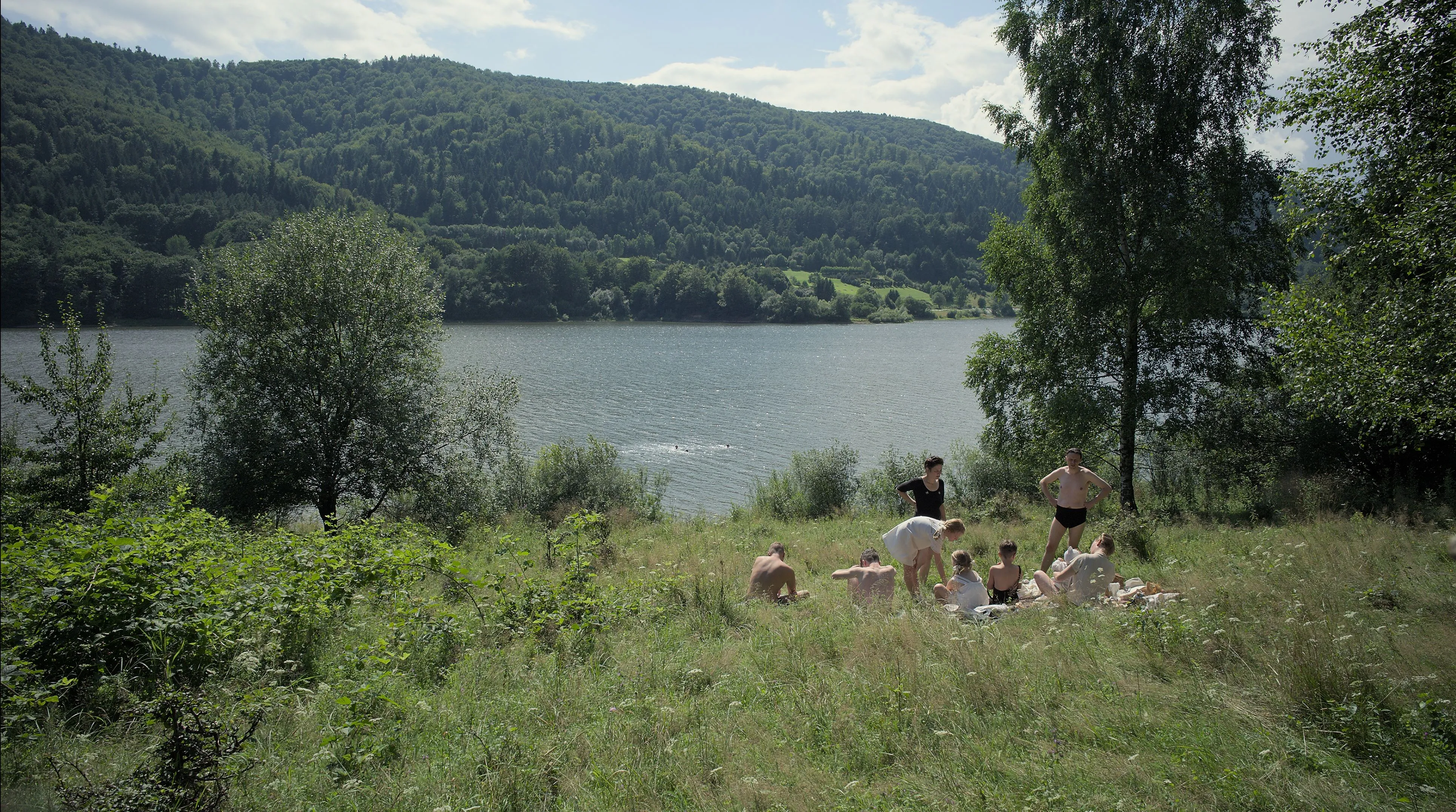
Banal, bucolic charm acting as a façade for evil is hardly a new notion, but it is one given a new kind of horrendous life in Jonathan Glazer’s first film in 10 years, a loose adaptation of Martin Amis’s The Zone of Interest. Here, we are introduced to a picturesque country house in Poland – the home of Auschwitz camp commandant Rudolf Höss (played by Christian Friedel) and his family, with the death camp itself lying just beyond the garden walls. It’s a needling new way to look at the Holocaust on film, following the mundane daily lives of some of the most evil people in history while pure horror happens just off-screen, but in Glazer’s commitment to ‘the banality of evil’, The Zone of Interest ends up mostly just playing one note, and it’s not quite a profound enough one.
While Amis’s novel took a more obviously ‘dramatic’ approach to the lives of its heinous subjects, Glazer does away with most of that here. Instead we mostly just see the unremarkable domestic routines of Rudolf and his wife Hedwig (Sandra Huller), who refers to herself as ‘the Queen of Auschwitz’ with a stomach-turning glee, as they have dinner, put the kids to bed and host parties for other Nazi bigwigs. Though this really isn’t a film for big performances – we’re, understandably, never invited to look upon the Hösses as actually human – Friedel and Huller do impressive work in near-impossible roles, aided by excellent costuming (Rudolf’s formal outfits have a habit of making him look like an overgrown schoolboy) and some of the most actively repellent haircuts ever committed to film.
Glazer never shows us the horrors within Auschwitz directly, but we do hear hints of them. The sound design is probably The Zone of Interest’s strongest suit, the general domestic bang and clatter underscored by distant screams, gunshots, and the whir of the machinery that facilitated death on an industrial scale – noises ignored by both the German family and their Polish housekeepers. It’s a point Glazer hammers home a lot, but to diminishing returns – the idea of the Nazi project as one being run by sadistic yet pathetic mediocrities isn’t actually a particularly novel one, and so this cold approach eventually runs out of steam.
That’s not to say there aren’t snippets of greatness here. For one, Mica Levi’s score – despite being very sparingly used – is yet another pantheon entry into the canon of the best film composer currently working, and its arrival always heralds The Zone of Interest’s most effective scenes. These come in the rare form of Glazer switching up his style from the dispassionate minimalism of the domestic scenes to something stranger, be that infrared footage of a young girl sneaking around the camp at night mysteriously scattering fruits or a moment in which the film itself seems to rebel against the evil within it.
The whole screen turns red as Levi’s score screams out, before abruptly shifting back to ‘normalcy’. It’s a hugely startling moment, and I found myself wishing for more of this openly confrontational style as the film went on. We do get it once again, in a truly fascinating ending in which Höss seems to commune directly with our present, but these breaks from literal reality also serve to highlight the problem with the overly studied approach elsewhere. There are many ways, or also perhaps none, to effectively convey real evil and tragedy on screen, but something that is impossible is outsmarting it.
 Jack Blackwell – Film Reviews