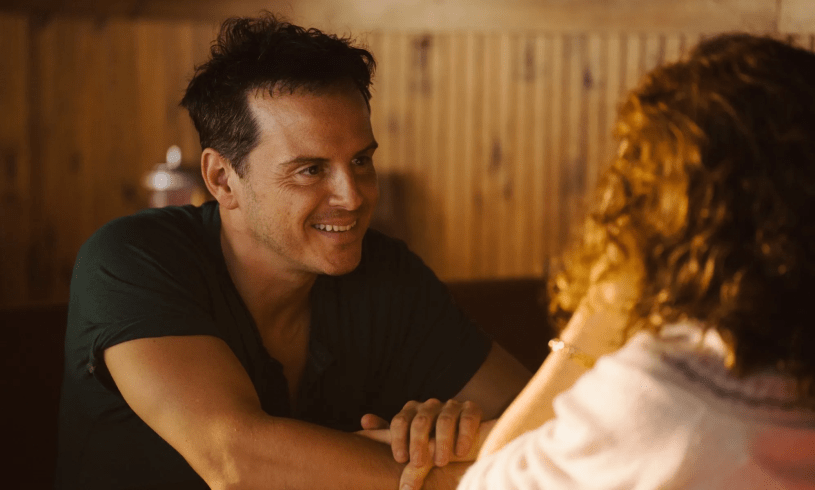

After taking a break from the big screen with his BBC series The North Water, Andrew Haigh returns to cinemas with All of Us Strangers, his finest film yet. He’s already one of our finest portrayers of loneliness and the connections we can make to pierce that solitary darkness, but he ascends to another level here with this magical realist fable of familial love, missed opportunities, and the power of writing to almost commune with the past and the dead that reside there. It all adds up to an early contender for 2024’s most purely moving film, a sparklingly empathetic and stylish tribute to the power of love.
Adapting the novel by Taichi Yamada, All of Us Strangers has one of the year’s most immediately intriguing premises. Gay 40-something screenwriter Adam (Andrew Scott) leaves his chic London flat to head out into the suburbs and visit his parents. It just so happens that his parents died when he was 12 yet, when he gets to his childhood home, there they are, the same age as they were the day they both died in a car crash. It’s a nervy first encounter, but it’s not long before Adam is sharing his life story with his dad (Jamie Bell) and mum (Claire Foy) and promising to live again.
Haigh handles this supernatural premise with a satisfying mix of elegant mystique and more practical concerns. Everyone involved is aware that this *shouldn’t* be happening, but they’re all too excited about the fact that it *is* happening to pay the reality-warping too much mind. The parents know they’re dead and have been since 1987, and Adam can give them a glimpse of the ‘future’ that he now resides in, and the ability of Scott, Bell, and Foy to play this all completely straight is nothing short of incredible as they rebuild a family unit in miraculous circumstances. It’s career-best work, or at least close to it, from everyone involved.
It’s not entirely smooth sailing, though – Adam has to come out to his parents and while they’re not committed bigots by any means, their ‘80s attitudes haven’t had the chance to catch up to Adam’s time. Scott does an incredible job mixing the frustration and patience of having to explain a new world of tolerance to people who aren’t necessarily opposed to it, but still have trouble, and it’s profoundly moving when the hurdles are finally overcome – the scenes between Scott and Bell in particular go directly, and mercilessly, for the tear ducts.
Alongside these moments of magic sits a slightly more grounded, but still just a little otherworldly, love story as Adam meets Harry (Paul Mescal), one of the very few other people to have moved into Adam’s newly opened and desolately empty high-rise. Their relationship is delightful, two people giving each other complete trust, brought to life by a sublime pair of performances that play off of each other brilliantly. Haigh also uses the age gap to tie the two plot strands together with the running theme of gay progress in the UK, from the casual homophobia of Adam’s parents, to the differences between Adam and Harry, from language (‘gay’ vs ‘queer’) to the notion that Harry didn’t have to grow up with a deathly fear of AIDS.
It’s a clever real-world grounding for an otherwise fantastical tale, one that Haigh grants further mystique to with a beautifully dusky colour palette and just slightly eerie score, though this is relatively often interrupted by a soundtrack of the ‘80s songs that Adam shared with his parents. It’s such an enrapturing atmosphere that you almost don’t even notice just how *small* All of Us Strangers is – the four mentioned characters are the only ones we ever see, the mix of intimacy and ominous emptiness proving a perfect marriage for this profoundly kind ghost story.
You can tell early on that All of Us Strangers is building to the ‘Big Cry’ ending, and it certainly delivers on that front – even being fully forewarned that it’s coming doesn’t dull its impact – but it also allows itself one final surreal note. At first it feels like Haigh might have just overplayed his hand at the last, but as the finale really settles in, the tears dry as a sense of pure wonder replaces them. Love as a force to transcend time and space is a well-worn trope, to be sure, but in Haigh’s hands it feels new again, a cosmic revelation.
 Jack Blackwell – Film Reviews