
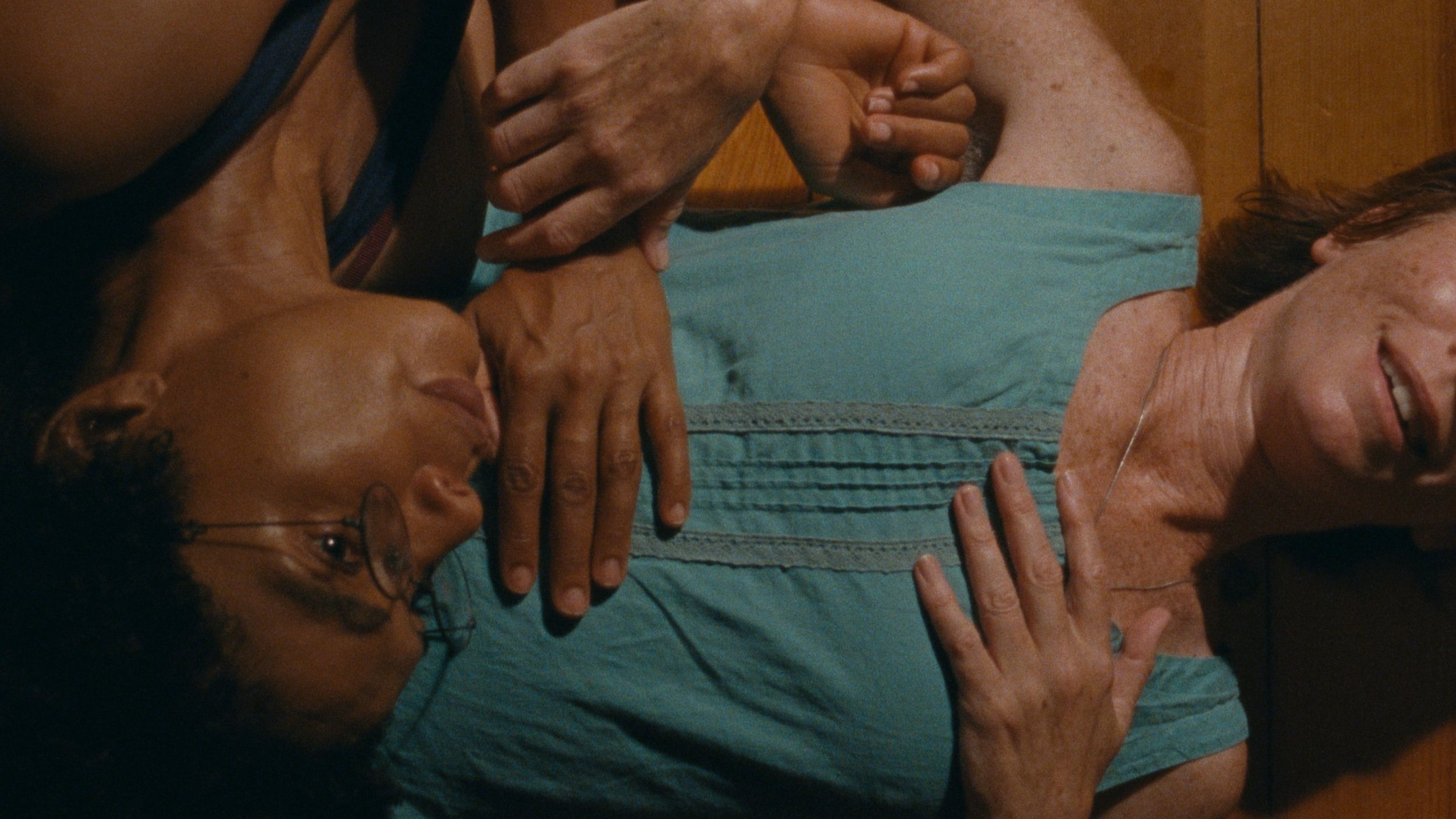
As is all too often the case with A24’s less overtly accessible films, Janet Planet arrives in the UK with next to no fanfare, a marketing campaign that one could generously term non-existent, and playing in just a handful of screens across the country. It’s a bit of a shame, but perhaps an inevitable fate for playwright Annie Baker’s film debut, an ethereal mother-daughter drama that is defiantly quiet and meandering, set across one seemingly endless summer and thus taking plenty of time to go nowhere in particular. It’s a frequently frustrating prospect, yet also just as often a gorgeous one, and absolutely one that benefits from being sought out on the big screen, as tough a task as that might be.
Set in the hazy, mobile phone-free, and easy to idealise past of 1991, Janet Planet follows Janet (Julianne Nicholson), a hippy-ish acupuncturist, and her 11 year old daughter Lacy (Zoe Ziegler) across a lazy but also fraught summer holiday. It’s the last summer before Lacy goes to middle school, a milestone that has made her both melancholic beyond her years (her first line in the whole film is ‘I’m going to kill myself’) and yet also regress into infanthood, becoming incredibly needy and possessive of Janet’s attention.
Baker keeps the drama at very natural, never particularly heightened levels, even as Lacy competes with Janet’s various ‘outsiders’ for her mum’s affection – the story is broken into chapters named after each of these interlopers; brooding boyfriend Wayne (Will Patton), flighty English old friend Regina (Sophie Okonedo), and spiritual artist Avi (Elias Koteas). The result is something very vignette-y and unhurried – at one point, Lacy struggles to pronounce the word ‘languorous’, but it’s an idea the film around her is intimately familiar with.
Sometimes, this is effectively immersive – DOP Maria von Hausswolf’s gorgeous cinematography, everything lit just masterfully, and a quietly vibrant soundscape makes Janet Planet, at least visually and sonically, warm and rich and oh so inviting. Yet, there’s also plenty of patience-testing stuff, particularly later on (did we really need two different extended static shots of an oven being turned on), and the writing is often actually a bit unremarkable. Most of the richness and texture of these characters comes more from the performances themselves than what anyone is actually saying, Baker indulging in that annoying but not uncommon indie debut trick of using silence to suggest depth without putting in enough of the work to actually, you know, have depth.
The most interesting stuff comes early on, with cruddy boyfriend Wayne. As his sullen presence becomes less and less bearable for Lacy, Baker starts to frame him like some sort of fairytale ogre, indulging in an eerie otherworldliness that is very welcome whenever it pops up again. Having already won a Pulitzer for her stage work, Baker hardly needs Janet Planet to prove her as a writer, so perhaps it makes sense that it’s her formal work here that is far more interesting – despite the occasional bouts of lethargy, this is a stylish and, to use the old cliché, *cinematic* debut that promises great future things from Baker the director.
 Jack Blackwell – Film Reviews