
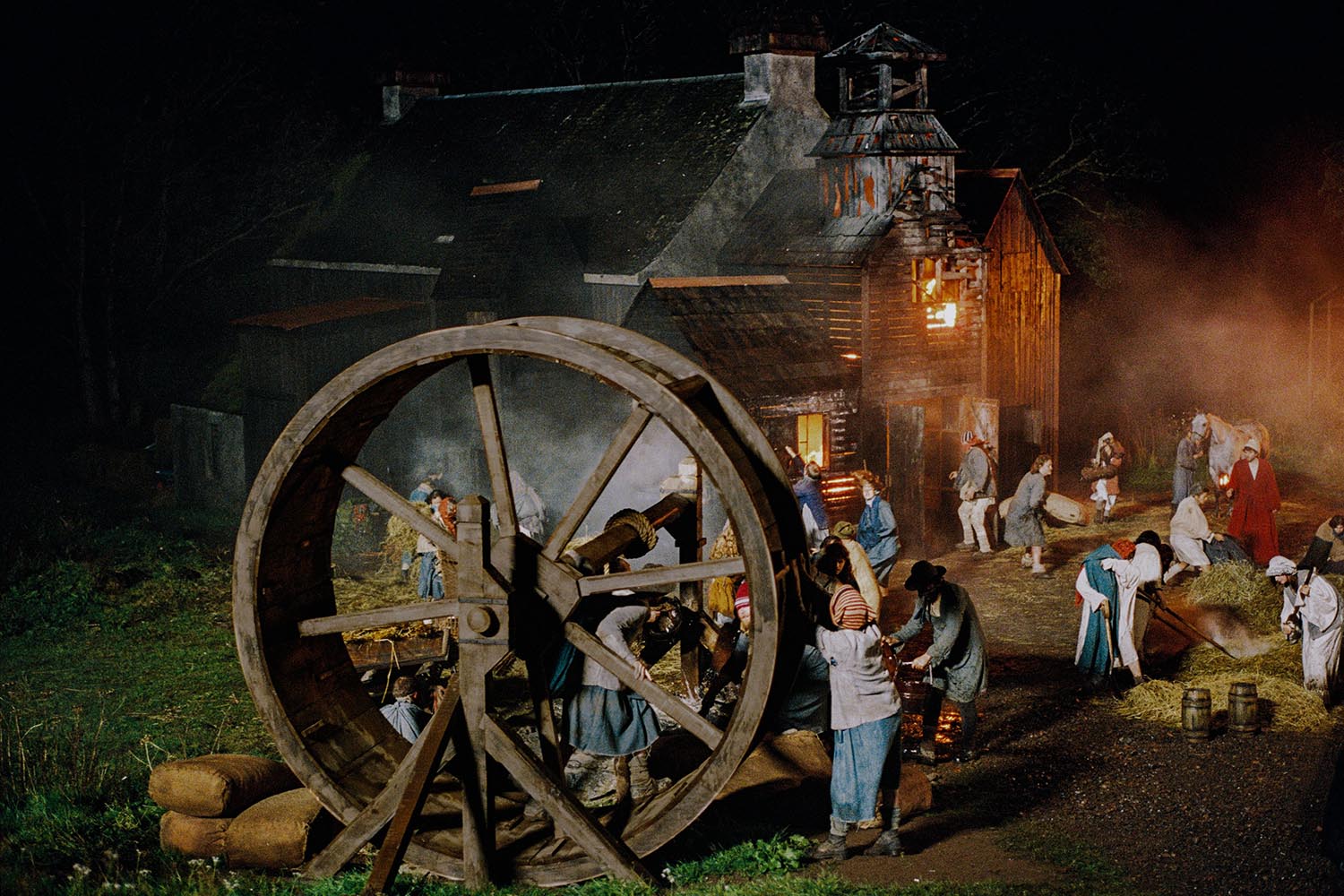
There are a lot of big push-pull ideas at play in Harvest, the first English-language film from Greek writer-director Athina Rachel Tsangari; capitalism vs collectivism, racial hierarchies vs class-based ones, organised religion vs paganism, all playing out in 17th Century rural Scotland, against a backdrop of ruggedly gorgeous scenery. With all this in the bag from the start, it’d be hard to make Harvest utterly uninteresting and yet, against all odds, that’s exactly what Tsangari does. Despite its intellectual and visual heft, the 130-or-so minutes of Harvest go by absolutely interminably, weighed down by a leaden foundation of being both boring and unconvincing.
Adapting the novel by Jim Crace alongside co-writer Joslyn Barnes, Tsangari is far more concerned with mood than plot in drawing out the story here. We’re dropped into a largely self-sustaining remote village that, initially unbeknownst to the inhabitants, is seven days away from destruction – the land’s posh English owner has instructed the otherwise kindly overseer Master Kent (Harry Melling) to map out the lands in order to have them converted into much more profitable sheep-farming fields. Matters are further complicated by the arrival of some mysterious outsiders, who are swiftly scapegoated for a recent barn fire and shoved into the pillory stocks, adding a cursed hostility to the settlement.
All this plays out immensely slowly, and in Tsangari’s commitment to atmosphere ahead of anything really happening, the village becomes less and less believable as time goes on (not helped by the horribly inconsistent dialogue, which flits between period and modern seemingly at random). It is a bit counter-intuitive that this ‘immersion’ work actually has the opposite effect, but the indulgently languid pace ends up making the village seem like an excursion or exercise from a drama school – these people don’t feel real, never escaping the sense of being actors playing pretend in one of those historical model villages you might go on a school trip to.
Suffering most from this is Caleb Landry Jones as the ostensible lead of the piece, Walter, a childhood friend of Master Kent who is less yokel-y than his neighbours. His performance is painfully laboured, struggling to escape from a simply terrible accent that only seems to get further and further from resembling anything actually Scottish as the film goes on. Melling too is hamstrung by the accent work, and though Rosy McEwen, as a xenophobic widow, handles it better, you do wonder why Tsangari couldn’t have just cast actual Scots as her leads.
In fact, it’s in the complete escape from Scottish-ness where Harvest finds its sturdiest footing, with the character of the map-maker, Mr Earle (Arinze Kene), an amiable West African man who is gifted at his craft. It’s him who provides the one period detail that feels both true and unique, his map of the area proving a wondrous sight to the villagers, who have never been able to put their old familiar world to paper – Walter is particularly struck by the ocean at the edge of the map, a place not very far away that his tiny life has never even let him visit.
It’s the occasional grace note like this, as well as some nice quasi-Malickian camerawork (look out for some beautifully purple skies at dawn and dusk), that stops Harvest from being a complete bust, but the film around them is far too dull to recommend. Even when things start threatening to actually *happen* (some soldiers arriving, a magic mushroom trip, a doomed villager rebellion), they’re pulled off with such a lack of urgency that they just blend into the muddy blandness found everywhere else.
 Jack Blackwell – Film Reviews