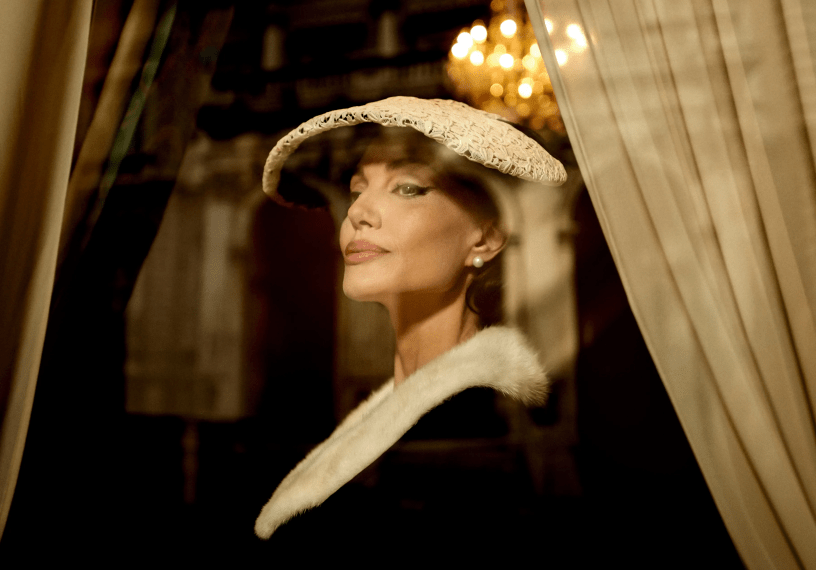

After Jackie in 2016 and Spencer in 2021, Pablo Larrain now completes his spiritual ‘women in gilded cages’ trilogy with Maria, perhaps the most intellectually interesting but the least immediately emotionally gripping of the three. This biopic of the last week of the life of beyond-legendary opera singer Maria Callas (Angelina Jolie), is in constant conversation with its predecessors, uniting this triptych of powerful yet trapped, beloved yet lonely, and ultimately sad and dead women in a fascinatingly self-critical yet cold way.
Though there are a decent amount of flashbacks, the majority of Maria is spent across one week in Paris, as Maria tries to reunite herself with the singing that once defined her (she hasn’t performed publicly for over four years and her voice has deteriorated in the time), even as she starts to realise that the end is imminent. Accompanied by her butler Ferruccio (Pierfrancesco Favino), her cook/housemaid Bruna (Alba Rohrwacher), and a hallucinatory personification of her sedative-of-choice Mandrax (Kodi Smit-McPhee), she finds herself lost in reverie, trying to come to terms with the life choices of both Maria the human and ‘La Callas’, the diva.
Even though Maria can feel like it’s keeping you at arm’s length (the Mandrax stuff, as it/he interviews Maria for an equally hallucinatory film project, is especially hard to break in to), it is the perfect role for Jolie. She’s maybe the only living actress with the sort of ethereal mystique to seamlessly blend her own legend with that of Callas’s, and she manages a fantastic balance of regal absurdity, artistic fervour, and a genuine, almost childlike, vulnerability – often hitting all these notes within just one conversation. It’s the exact sort of work that plays very, very well come Oscar time and though the rest of the film might be too chilly to break through in the same way, Jolie’s current Best Actress frontrunner status comes as no surprise.
If any other element of the film stands an awards-y chance, it’s Edward Lachmann’s cinematography. Searching close-ups meld with beautiful framing of the luscious interiors to give a real sense of texture to this world, while his vision of Paris is a perfect fit for a story of fame and fading life, always bathed in a golden autumnal glow. Even more than its predecessors, Maria feels like a particularly cloistered film, Larrain and returning writer Steven Knight cutting it off from any intrusions from the ‘real world’, and Lachmann’s old-fashioned sense of beauty here really completes the effect.
The upshot of this is, inevitably, an emotional remove, especially if, like me, the world of opera is even more alien to you than that of the White House or the Royal Family. With recurring elements from Jackie (in the form of a reappearance of Caspar Phillipson as JFK) and Spencer (the spectre of Anne Boleyn), Maria’s sense of being a closing chapter works exceptionally well on both a direct and a meta level, but it just can’t quite make the tragedy of this finality stick.
 Jack Blackwell – Film Reviews