
From Shame to Widows to the Small Axe collection, most of Steve McQueen’s rich, layered, sometimes upsetting work is hard to condense into short summaries, basic overviews of plots or characters not adequately reckoning with the subtleties of the work. The same cannot be said of his latest, Blitz, which, despite being perhaps his grandest-scaled film yet, is also by far McQueen’s simplest – boiling down, basically, to ‘a boy needs to get home to his mum’. It’s a straightforward focus for this World War 2 epic, which is sweeping and sweet, but also sometimes stodgy and frequently badly tonally muddled.
Getting a family-friendly 12a/PG-13 rating for the first time in his directing career, Blitz does feel like McQueen making a conscious foray into more kid-friendly stories, with the central journey bearing, at various different points, resemblances to Paddington, the early Harry Potter films, and Dickens and Dahl novels. At its heart is 9-year-old George (newcomer Elliott Heffernan), a mixed-race boy who has been evacuated to the country by his loving mum Rita (Saoirse Ronan) but ends up jumping off his countryside-bound train just an hour into his trip and facing a boy’s own adventure as he walks back into the dangers of a bombed-out London to reunite with his family.
It’s a fun story on its face, and there is some very exciting stuff on offer in Blitz, but McQueen, both as writer and director, gets stuck in an awkward space between two modes. A lot of the plotting feels overly simple while the dialogue is very on-the-nose in ways that kids’ movies often are, but there’s too much grime and sleaze for Blitz to quite qualify as a real ‘family film’. A lot of these problems are at their worst when George runs afoul of a very Dickensian street gang, featuring wildly broad performances from Kathy Burke and Stephen Graham, leading to a frankly bizarre set of sequences that never feel natural to the world the film has built so far.
Faring a lot better are the moments (this is a rather vignette-y film) in which Elliott runs into, first, a trio of young brothers who have also run away from evacuation, all of these four boys giving lovely and moving performances and, second, Ife (Benjamin Clementine), a Nigerian air raid warden. Ife gives George an insight into the heroism it takes to keep London safe in this time of crisis as well as a new way of looking at his own racial identity – as you would expect from a McQueen film, Blitz is sharp on the racial dynamics of Britain in both their complexities and bleakly brutal simplicities.
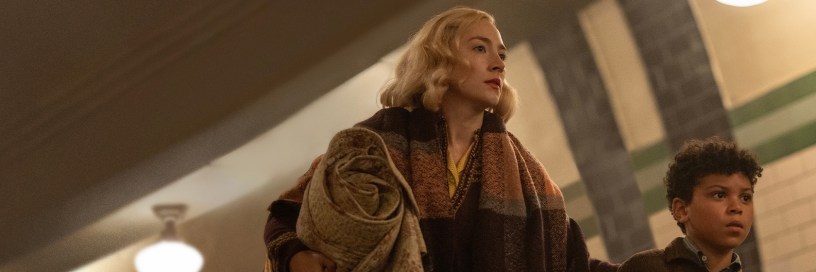
As this review so far might have suggested, Ronan’s Rita has far less interesting stuff to do than Heffernan as George (though she does fare better than Harris Dickinson, who is astoundingly underused as local firefighter Jack), but she still puts in a typically solid performance, convincingly capturing the working class community spirit of the London of the era. She’s also costumed and made-up just fantastically, always more glamorous than those around her, shining bright even as she fades from the plot.
All the biggest set-pieces fall to George (apart from, probably, the best one in the film, which is actually the first scene, a particularly chaotic and heart-in-mouth firefighting sequence), from being caught in the midst of a bombing raid to the centrepiece flooding of a tube station being used as a shelter. These are all well-marshalled by McQueen, though not quite with the power and swagger of his best formal work in Widows and Mangrove (and backed by a frankly pretty bad score from Hans Zimmer), making good use of his Apple TV-backed money to build up and then destroy a convincing ‘40s London.
Blitz is not just McQueen’s most approachable film yet, it’s also his most traditionally ‘British’, drawing on classic standards of family-friendly UK films and literature and even seemingly pulling from some of the infamously harsh 1970s public information safety films. It’s a noble and ambitious approach, serving as a reminder that Black stories always made up an important part of UK culture even when ignored in those mainstream channels, but it turns out that Enid Blyton-style fun and escapades are not a natural fit with McQueen’s established strengths. That a film this generally entertaining and solid can be one of the year’s major disappointments speaks more to the strength of McQueen’s back catalogue than anything else, but Blitz fails to live up to its initial promise.
 Jack Blackwell – Film Reviews