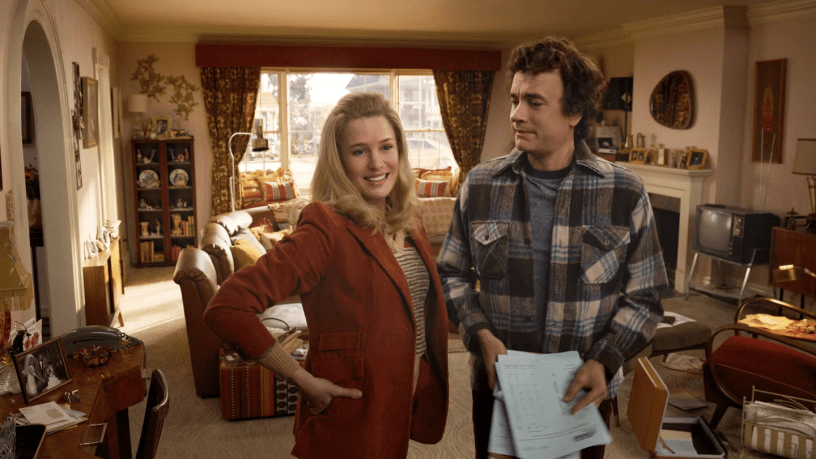

If you could see your home from the dawn of existence to now, how many lives would you bear witness to, to how many experiences would you feel a strange, intangible connection to? It’s a head-spinning question, one answered in typically madcap fashion by Robert Zemeckis in Here, which, adapting the graphic novel by Richard McGuire, takes a tiny corner of the northeastern US, plants an unmoving camera, and just follows *life* from the end of the dinosaurs all the way to the COVID pandemic years. It’s a bold and often deeply flawed experiment, one that flounders just as much as it succeeds, but is just so damn ambitious and earnest and fully cinematic that it’s impossible to resist.
Aside from Zemeckis himself, the headline names here are Tom Hanks and Robin Wright, reuniting with each other and their shared director 30 years after Forrest Gump, but we don’t actually meet them for almost the first full half-hour of Here. Instead, we’re treated to the vignettes of all the other stories we’ll be dropping in and out of – a Native tribe in the pre-colonial era, Ben Franklin’s son and some Revolutionary soldiers, a turn-of-the-century flying enthusiast, the inventor of the La-Z-Boy chair in the ‘40s, Hanks’s characters parents, and a modern Black couple in the 2020s.
Through it all, the camera remains fixed in the corner of the living room (or, before the house is built, where this corner will eventually be), as we see Hanks and Wright, playing couple Richard and Margaret from 18 to old age, navigate life across the changing decades of the ‘60s to the ‘90s in a fundamentally unchanging environment. Though the de-aging effects for them in their younger years are just ugly as sin (and no amount of CG varnish can hide the bizarreness of Hanks’s nearly 70-year-old voice coming out of a teenager’s mouth), they each give impressive performances, finding rock-solid emotional cores within the film’s strange and often very stagy central conceit.
A lot of the other plot strands are less successful. As Richard’s mum and dad, who buy the house just after World War 2, Kelly Reilly and Paul Bettany are just awful, while every flashback to the Franklin family or the La-Z-Boy guy and his wife bring nothing to the table outside of being a bit baffling. Just these excursions might have been enough to kill the film, but Zemeckis and co-writer Eric Roth find just enough moments of life’s beautiful poetry to save it. A particular scene in which Richard and Margaret’s daughter is born, cross-cutting with the birth of a child in the pre-colonial era, all parents and babies looking up at the same moon a thousand years apart, is immensely moving.
It’s also hard to dismiss a film as formally bold and inventive as this. Both as a journey through time and an adaptation of a graphic novel, Here is put together like almost nothing else I’ve seen, Zemeckis cutting out panels of the frame to allow two, three, or even more moments in history to exist side by side. It’s a remarkable feat of not just editing and cinematography, proving that you don’t need a mobile camera for an epic scope, but also emotional resonance – every life lived is lived in tandem here, the human experience having no clean beginnings and endings.
It’s this overarching empathy and humanism from Zemeckis that makes Here far more than the sum of its sometimes really quite terrible parts. Yes, there is plenty of bad acting and weirdly waxy, computerised faces delivering said acting and, yes, the vignette approach means that no one single story is, on its own, *enough*. But that’s the point; no life lived in a vacuum is enough, whether you’re an inventor, a war veteran, a mother, or a hummingbird. We are all part of one great totality. It’s a ludicrously earnest and wide-eyed thesis, one that will embarrass and frustrate plenty, but delivered with so much emotional and stylistic confidence that it deserves your consideration.
 Jack Blackwell – Film Reviews