
If and when humanity finally departs from our planet, what creature might take our place as Earth’s stewards? It’s the sort of question popularly answered on the internet with cats, an answer not entirely disagreed with by Gints Zilbalodis’s magical, wordless post-apocalyptic animation Flow, which finds as its hero a black cat, but also gives as its own retort that, without us there to ruin everything, maybe the animals of Earth can remake it in a new, shared image. It’s a sweet and mysterious message from a film that often feels like it’s drawing a creation myth for a new and better world.
Flow’s world is one of the kind you more often see in videogames than films, reminiscent of not just the 2022 post-apocalyptic cat simulator Stray but also works like Journey or Shadow of the Colossus, in which a collapsed world holds silent mysteries that are never to be answered. Humanity was here, once, but seemingly left in a mighty hurry (a sculptor’s workshop still has undisturbed wood shavings around a piece in progress), and now animals reside in these formerly civilised places. Our hero cat lives in a house on a hill, enjoying the luxury human comfort of an actual bed, until a cataclysmic flood puts everything it knows deep underwater.
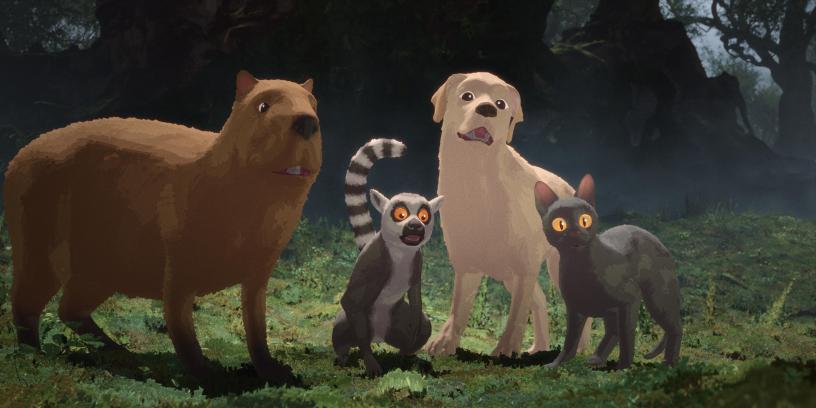
Soon, the cat is rescued by a sailboat – this is to become a Biblical Ark in miniature, with a capybara in the Noah role as it picks up first the cat, then a lemur, then a bird of prey with a broken wing, and finally a goofy yellow Labrador, a crew that sails towards a mountain range on the horizon. These animals are animated just beautifully, with fluid motions counterbalancing their rough-hewn edges, a mix of hand-sketching and CGI. Even without any words, it’s always easy to know exactly what each creature is thinking and feeling, and it’s impossible to not feel a profoundly protective urge for every one of them.
Though they are more co-operative and capable than their real-world counterparts, these animals always feel completely real, which just makes the mystery of the hypnotically beautiful world around them that much more compelling. Submerged forests, towering mountains, and gleaming yet utterly empty cities all have a hint of the outright magical (not to mention the giant wooden cat statues), and what this world was before and how it entered this state now are left completely unanswered, the human world as mysterious to us as it is to the animals.
The end result is world you feel you could spend hours upon hours in without ever losing a sense of wonder, though Zilbalodis leaves us wanting more with a brisk, sub-90 minute runtime. Come the end, you may not quite get what it all *meant* (obviously there’s a bunch of climate change stuff in here, but plenty of other, more opaque layers too) and, despite a U rating, I’m not sure how well its enigmatic quiet will actually play with younger audiences, but this is one of the prettiest and most singularly original films of the year.
 Jack Blackwell – Film Reviews