
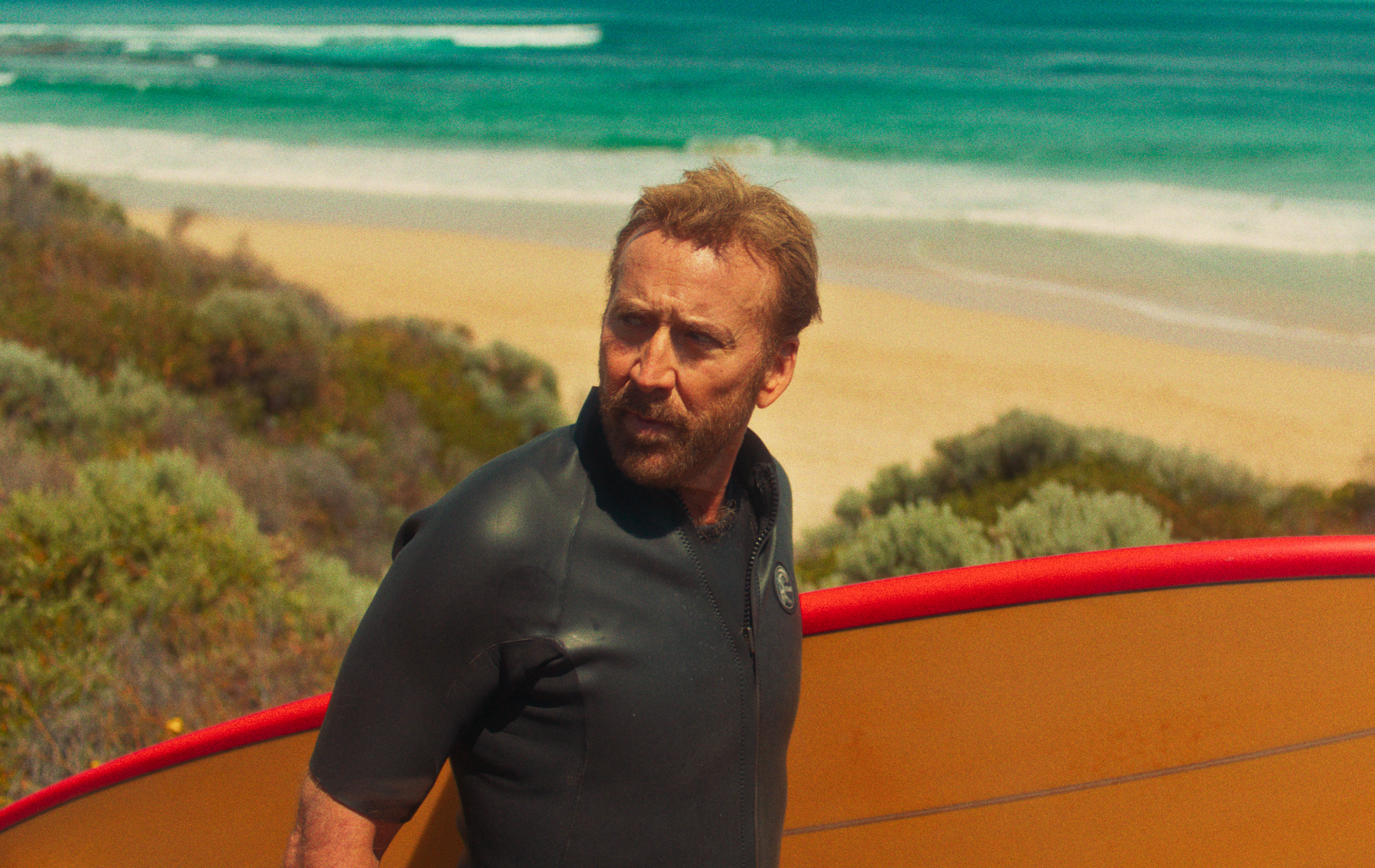
Plenty of Nicolas Cage films end up with his characters losing their mind, but not since Werner Herzog’s Bad Lieutenant in 2009 has one of them gone so mad, so fast as he does in Lorcan Finnegan’s The Surfer. As the unnamed surfer of the title, Cage, in a furious, semi-delusional mode from the off, starts out at at least a 7 on the Cage freakout scale before some heavy escalation, playing a man who isn’t just losing his mind, but seems to actively seek madness, scorched by the hot Australian sun and a dangerous amount of wounded pride.
The surfer, an American who grew up in Australia and is back in the country to buy his dead dad’s old house, starts out with a simple goal for the day – to go surfing with his teenage son on the beach near his old neighbourhood, where the waves offer the perfect view of the idyllic home that he’s currently in a bidding war for. It all collapses when a gang of angry local surfers, led by the Andrew Tate-esque ‘masculinity guru’ Scally (Julian McMahon), take offense to this (it’s a ‘locals only’ beach) and humiliatingly banish the pair, setting in motion a complete breakdown for the surfer.
Trapped initially by pride and then by the progressive loss of his wallet, phone, car, and all other worldly possessions across a few days, the surfer simply cannot leave the beach and its attached car park, sort of like Bunuel’s The Exterminating Angel, only with less stuffy dinner and more Aussie coastline. Sometimes furious, sometimes desperate, pretty much always frustrating and tragic, the surfer is not a role that particularly takes Cage to new places, but he’s still magnetic here; you’re unable to take your eyes off of him even as he starts pocketing dead rats to eat later.
This circular story and unchanging location does make The Surfer feel a decent stretch longer than its 100-minute runtime, which is both curse and blessing – you feel as trapped and delirious as the ‘hero’ of the piece as basic things like fresh water and uninterrupted sleep become scarce. Finnegan and writer Thomas Martin keep a good balance between the pure hallucinatory madness and some more concrete things to say about the sacrifices of the soul demanded by masculinity and financial success, coming together nicely in an overstretched but eventually hugely cathartic conclusion.
In the best way, it’s almost a relief to escape The Surfer, if only to get out of the searing, maddening heat that seems to emanate from the screen. A blazing sun, Cage’s ever-more crusty appearance (the costuming and make-up work here is understated but excellent), and the fact that every colour on screen pops out in its brightest form all work together to really sell the heatstroke and dehydration. By the end, you feel like you’ve just got back from the worst holiday of your life, which is not a sensation most films bother to chase, but this bizarre sort of success is exactly where The Surfer makes its home.
 Jack Blackwell – Film Reviews