
Sexual and queer awakenings go hand in hand with coming-of-age tales wherever you find them, but a quandary more rarely explored is what happens when the awakened, as it were, wants to put all those feelings back in the box, perhaps forever. It’s a question asked and answered with incredible intelligence and spiritual empathy in Urska Djucik’s absolutely remarkable debut Little Trouble Girls, a story that starts in the familiar and physical before subtly ascending into the divine and unknowable.
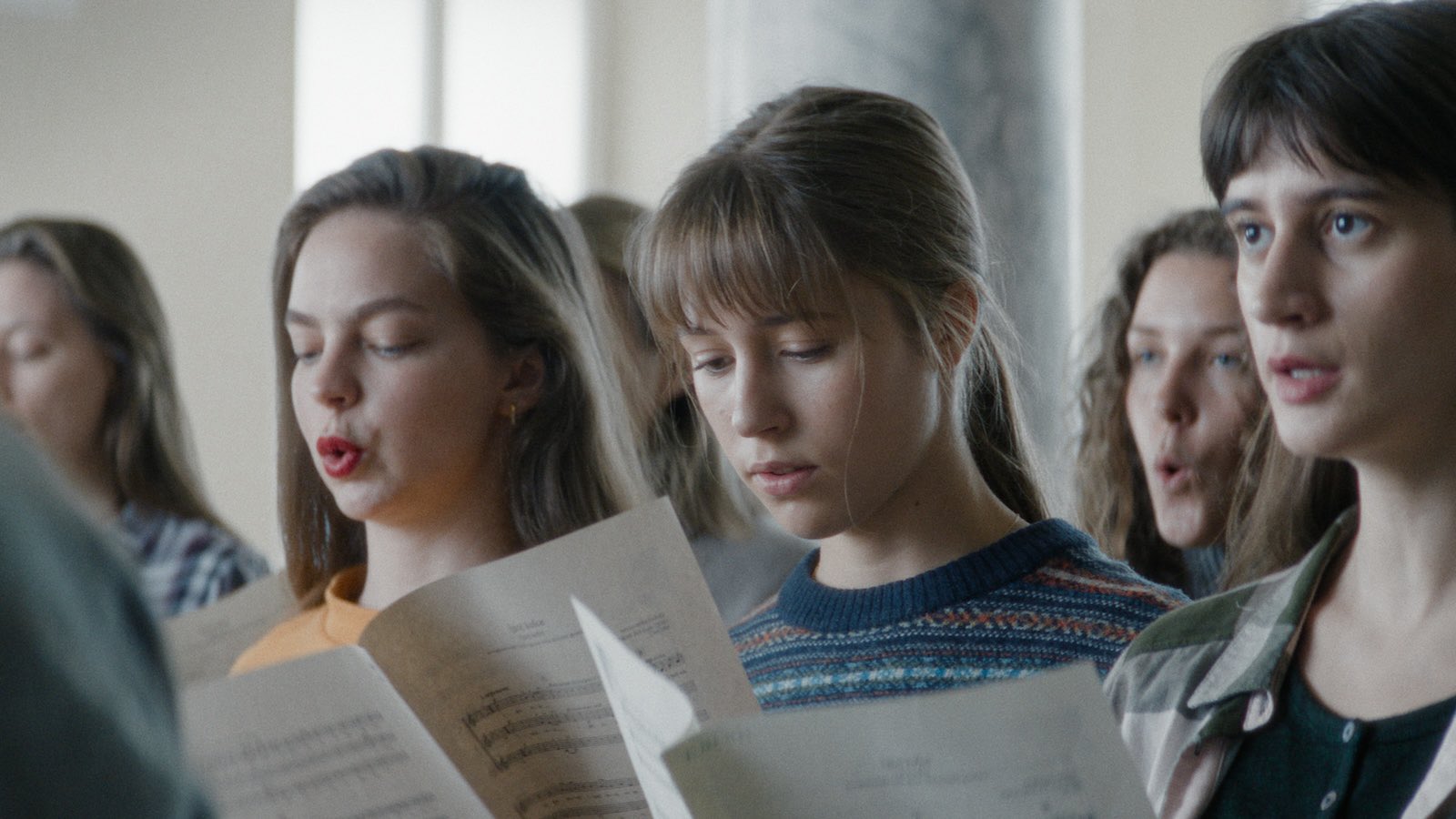
Djucik sets her story amongst a group of 16-year-old girls in a traditional folk choir, a gaggle of teenagers at an awkward age where some truly see themselves as women already but others are still very much children. Our heroine Lucija (Jara Sofija Ostan) falls into the latter camp; as one of the choir’s newest members, she’s timid, almost boyish, and alarmed by a new wave of emotions and desires that seem to her more scary and disruptive than exciting or full of possibility.
On a trip to a convent to practice singing in a traditional setting, Lucija falls into the orbit of Ana-Marija (Mina Svajger), a girl her complete opposite who has embraced the sexual possibilities of her approaching adulthood with gusto. Obviously, much of Lucija’s awakening comes via Ana-Marija (though it’s certainly sped up by the hunky builders working nearby who have a habit of swimming nude in the local river, unbothered by the girls’ wandering eyes), but Lucija’s own strange feelings stir something in the otherwise unflappable Ana-Marija too.
Both young actors, both making their debut here, play this extraordinarily well – a sequence in which Lucija marries her physical desires with her religious earnestness to beat a dare given to her by Ana-Marija is an incredible piece of silent epiphany for both, and serves as perhaps the centrepiece moment for everything the film is trying to do. Little Trouble Girls is, eventually, just as concerned with ephemeral faith as it is with the visceral realities of teenagehood, treating the Catholicism at its core with both scepticism and sincerity in a way that feels truly rare, building to a simply exquisite finale that is both transcendent and melancholic as Lucija faces up to her destiny.
The singing itself is brilliant too, beautiful music preceded by breathing exercises that Djukic shoots in extreme close-up until they become minor exorcisms, the frantic energy of the girls being expelled into something society might deem worthwhile, even sacred. If these are exorcisms, then the exorcist is the conductor (Sasa Tabakovic), the only male character with a speaking role, who is himself frightened of the girls in his ‘care’. After Lucija confides in him about love and desire, he becomes actively hostile towards her; a sequence of him basically bullying her out of the choir is completely wrenching, Djucik avoiding the obvious grooming angle to explore yet another facet of sexual repression and the rage that can come with it.
It’s all shot beautifully too, rich summer light and old-yet-pristine architecture providing a gorgeous backdrop while close-ups push faces and bodies into a sort of abstraction. In both the holy art of Christianity and the buzzing nature of the local flowers, Djucik loads the film with yonic imagery in a way that could felt like an affectation in a less surefooted director’s hands, but here instead puts us right inside the mind of Lucija as she grapples with her feelings about her own body and the bodies of the girls around her.
The result is a film that does deal a little in taboo but is ultimately defined by its empathy and insight, Djukic avoiding trauma or threat as easy dramatic devices and instead finding something much more personal and unique. Just as Goran Stolevski’s similarly brilliant and religious debut You Won’t Be Alone did for North Macedonia back in 2022, Little Trouble Girls is the sort of film that doesn’t just put Djucik and her young cast on the cinematic map, but Slovenian film as a whole.
 Jack Blackwell – Film Reviews