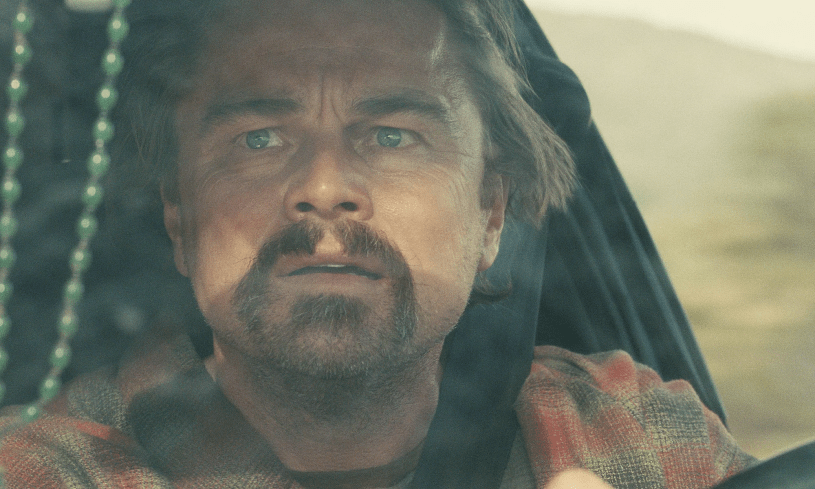

One of the overriding thoughts I had across the lightning-fast 160-ish minute runtime of One Battle After Another was, consistently, ‘how the hell did this get made?’ Now, that’s not because there’s anything wrong here – let me set out my stall early that this is another five-star banger in Paul Thomas Anderson’s incredible unbroken streak of five-star bangers. No, it just seems miraculous that PTA, one of the most brilliant but least bankable auteurs of our time, managed to convince a studio to give him a nine-figure budget for a conspiracy thriller with no easy elevator pitch that hinges on domestic terrorism, Black militancy, and the Nazi ideology hiding in plain sight in the US’s immigration policies.
Obviously, a big help to getting that sort of budget is the presence of Leonardo DiCaprio, who stars as Bob Ferguson (aka Ghetto Pat, aka The Rocket Man), a revolutionary demolitions expert who, along with his wildcard lover Perfidia Beverly-Hills (Teyana Taylor), becomes the target of maniac army colonel Steven Lockjaw (Sean Penn). As you might be able to tell from the outrageous names (see also: Benicio del Toro as Sensei Sergio St Carlos), One Battle After Another is PTA’s second take on Thomas Pynchon after Inherent Vice, this time much more loosely adapting Vineland.
It’s a sprawling, wordy story, spanning 16 years – the entire lifetime of Bob and Perfidia’s daughter Willa (Chase Infiniti, making an incredible film debut), who has spent her life in hiding with an ever more booze and weed-addled Bob before Lockjaw finds them and kicks off his ruthless hunt. To dive too deep into the plot would be to get lost in a haze – it is far, far more intuitive in practice than on paper, thrillingly unpredictable yet always coherent even as it ropes in elements from a skateboarding rebel gang to a civil war within an ultra-wealthy racist cult.
It’s another knockout PTA script, made sing by a great cast; DiCaprio’s unique ability to mix pathetic desperation with real movie-star shine is always a delight to see, del Toro is hilarious, and Taylor, though limited in screentime, has a lightning in a bottle energy that zips off the screen. Best of the bunch, though, is easily Sean Penn as Lockjaw. A man of many contradictions, Lockjaw is both a steely professional soldier and yet also a needy social climber, a white supremacist with a deep psychosexual obsession with Black women, and an adept tactician but strategic and social moron.
Penn plays all of this to the absolute hilt, his Lockjaw always *quivering* with something (rage, horniness, excitement, fear), hateful and frightening and consistently very funny, a pure villain who is both absurd yet also completely believable – you don’t need to look that hard at the modern US to find your real-life Lockjaws. OBAA is deeply, unabashedly political with no hemming and hawing about the morality of the revolutionaries or the pure evil of the American state, refreshing in a time in which entertainment is so frightened to offend.
And, alongside its rebel cred, OBAA really is *entertainment*, PTA’s most accessible and action-heavy film to date. Rooftop getaways, deafening shootouts, and absolutely exceptional car chases across the endless roads of the western US are all fantastically fun and exciting, all made so much grander by Anderson’s choice to shoot on VistaVision. While the use of the format here isn’t quite as breathtakingly spectacular as it was on The Brutalist last year, it does put OBAA, alongside Sinners, at the very top of 2025’s ‘Most Genuinely Cinematic Films’ list. Landscapes and empty interiors are vast and transporting, while close-ups are warm and beautiful (or, in Lockjaw’s case, frightening and gross), and the final extended set-piece, in particular, is made truly unforgettable by the lurching, stomach-twisting immersion of the cinematography.
It’s all backed by another absolute all-timer of a score from Jonny Greenwood, which feels like a synthesis of everything he’s done on previous PTA films. Sometimes possessed of a sort of ‘50s adventure film grandiosity, sometimes much more unnerving and dissonant, it always elevates the action, supported by a perfect set of licensed songs on the soundtrack – who knew that a karate demonstration set to Steely Dan’s ‘Dirty Work’ could be so arresting?
For all its well-earned hype (and whispers of finally being the PTA film to win him his overdue Best Picture Oscar) One Battle After Another is not quite Anderson’s masterpiece – but then, what sort of filmmaker could top his own best-day brilliance when said brilliance is There Will Be Blood and the literally perfect Inherent Vice. It is, probably, the best film of 2025 so far though, a truly rich mix of PTA’s typical dense writing and gorgeously lit California locales and an honest-to-god action film that doesn’t miss a beat in carrying one of *the* great filmmakers of the last 30 years into a whole new sense of scale. As Lockjaw says to one of his rebel captives being forced into witness protection; ‘welcome to mainstream America’ – let’s just hope Anderson gets a warm welcome there.
 Jack Blackwell – Film Reviews