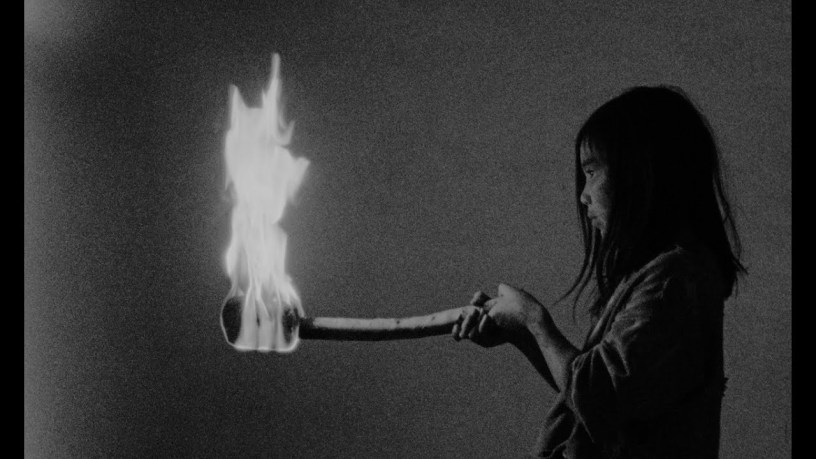

Though it, in its opaque manner, tackles climate change, the refugee crisis, and the random violence people inflict on others and themselves, the most powerful lesson Mare’s Nest, the new film from British experimentalist Ben Rivers, teaches is one of patience. This is a movie that starts out unbelievably, insufferably slow and abstract – by only its third scene, critics in my screening were already walking out having had their patience tested past its limit – but, if you stick it out, you may eventually, just about, come around to its rhythms. Does this mean I recommend it? Not at all, really, but, given how much I hated its first half, I have to note that I walked out of the ending far, far less peeved than I expected.
For all its confrontational refusal to conform, there is a plot of sorts to Mare’s Nest. Set during or after (the distinction becomes unimportant) a vague apocalypse in a world populated exclusively by children, Rivers gives us eight chapters in the life of Moon (Moon Guo Barker), a philosophically inclined British girl traveling the ruins of the world. Along the way, she meets roving bands of other, friendly, kids who have returned to some sort of primal tribal society of peace and play.
The most interminable of these is the aforementioned third vignette, which has Moon visit an oracle and her translator, with the trio then acting out Don DeLillo’s play The Word for Snow. This goes on *forever*, the kids trying their earnest best but clearly confused by the dialogue they’re given, and it’s hard not to bristle at the sheer tedium of it, not helped by the fact that it’s then followed up by another massively overextended sequence, this time of a bunch of kids playing in a cave filmed in long shot from about a mile away.
It was here that I had made up my mind on a one-star for Mare’s Nest, until a madly eerie later sequence of Moon investigating a series of tunnels that contain a bunch of perfectly preserved adult corpses, stuck in sculpture-esque poses while death plays behind their eyes. It transports you somewhere you really haven’t been in a film before, into a final stretch where Rivers’s unwillingness to please starts to charm, from a young boy playing an insane apocalyptic instrument that sounds adorably horrible to a glimmering joyride in the desert.
Filmed between the UK and Spain, Mare’s Nest benefits hugely from the astonishing landscapes and ruins Rivers finds, especially in Menorca, where mountains and mazes feel both ancient and like they’re from some lost future. Mostly, Mare’s Nest feels like it would be better suited to an art gallery than a cinema, where you could watch just one vignette and move on rather than power through a full 100 minutes of this stuff. Yet, if you fully stick it out and allow your brain to eventually start clicking to Rivers’s tempo, there are some rewards here, even if they are definitely too few and far between.
 Jack Blackwell – Film Reviews