
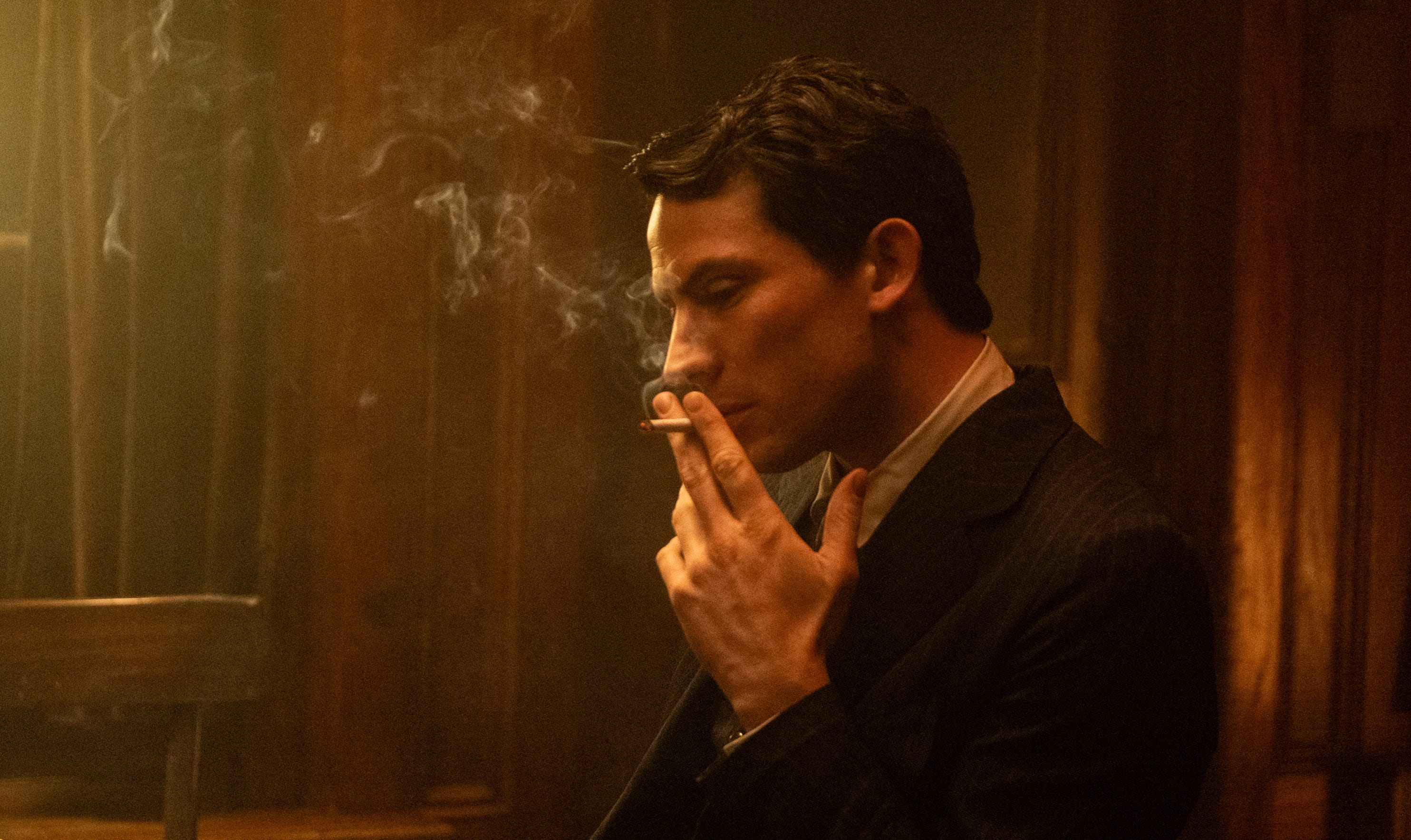
Oliver Hermanus’s last film, the Kurosawa remake Living, used sedateness as a strength, the quietness of the drama letting the emotions play loud. For his follow-up, The History of Sound, he has tried the same trick again, but to much more mixed effect – tamped-down voices and feelings work well for the tale of a dying old British man, less so for a decade-spanning American romance about the raw, heart-stirring power of folk music. It results in a well put-together and classily tasteful historical drama but, as a tragic romance, it ends up underpowered.
Hermanus does at least have a headline-grabbing lead duo in the form of Paul Mescal and Josh O’Connor, playing college classmates at the Boston Conservatory music school in 1917. Mescal is singer Lionel Worthing, a Kentucky farm boy with the words and sounds of that upbringing deep within him, while O’Connor is composer David White, a much posher academic who adores traditional American folk music and seeks to catalogue it for posterity. They connect almost immediately, before being separated by America’s entry into World War 1, for which David is drafted, before coming back together in 1920 for a Brokeback Mountain-lite trip into rural Maine, where the variety of isolated communities makes for a goldmine of folk music from different traditions.
It’s all shot very nicely and, despite some occasional overwritten moments in Ben Shattuck’s script (adapting his own short story and keeping things novelistic with omniscient narration from Chris Cooper), there’s an easy grace to the dialogue that feels authentic to this very specific setting. O’Connor, of course, is great as David (though he’s not in this quite as much as the marketing might make out), a wealth of history and secrets behind his eyes, though Mescal can feel a little miscast as the lead. He gets a few strong moments, no doubt, especially in an unexpected reunion with an old school friend that is just lovely, but I never bought him as the musical prodigy the film pitches him as.
For one, we are told Lionel has perfect pitch and – according to David – one of the world’s *great* singing voices. Mescal does not have either of these things, with his singing pretty good at best, while the passion for music itself, both for Lionel and the film around him, only arises in fits and starts rather than suffusing the whole story. The songs are wonderful when we get to hear them, though, as is the way Lionel explains the recording technology to the people whose music he and David are collecting.
The History of Sound has a wider scope than I expected, moving between countries and supporting characters at quite a clip after the Maine trip finishes up, which gives a nice epic sweep to proceedings at the cost of emotional focus. It ensures that there’s no room for the story to get dull or samey, but also keeps it chaste and distant when it really needed more punch to sell the tragedy and poignancy of its final act. There’s an ethereal fragility to the disappearing American music traditions that The History of Sound pays tribute to, and it captures that, but there’s an earthy, fiery heart too, and that’s missing.
 Jack Blackwell – Film Reviews