There are very few films made for the minuscule budget of $4 million that would dare to tackle a multigenerational epic fantasy that begins with the literal creation of reality, but that’s the exact sort of ambition possessed by Julia Jackman’s adaptation of Isabel Greenberg’s graphic novel 100 Nights Of Hero. It’s this gung-ho attitude that is the most impressive thing about an otherwise very limited film, one that is enjoyably cartoonish and colourful but is also eventually overmatched by its own financial constraints, not to mention a real thematic thinness and one of the most bizarrely paced final acts you’ll see all year.
Set within a fantasy realm created by a benevolent child god and then ruined by her meddling, rule-loving father, 100 Nights Of Hero takes us to a world defined by misogyny where women are compelled to remain illiterate and exist only to produce babies for their husbands. One of these such women is Cherry (Maika Monroe), married into an aristocratic family via her husband Jerome (Amir El-Masry). Expected to produce a male heir as soon as possible, Cherry’s purpose has been stymied by Jerome’s hidden homosexuality, and now, six months into marriage, her still being a virgin may end up getting her executed.
She’s given 100 nights to conceive, while Jerome flees again from sex by pretending to go away on business, leaving Cherry in a lose-lose situation with his hunky friend Manfred (Nicholas Galitzine), who Jerome bets cannot seduce Cherry within those 100 nights. If Cherry is not pregnant by the time Jerome gets back, she’s dead, but if she is pregnant, then it will be with Manfred’s child and, again, she’ll be dead. Her only ally is her maid Hero (Emma Corrin), a mystically gifted storyteller (and, secretly, a literate woman) whose tales have the power to alter time.
It’s a story that starts out a lot of fun, moving at a brisk pace between Cherry’s fears and gradual sexual awakenings for both Manfred and Hero, Manfred’s own scheming, and Hero’s tales. This is an interesting world to explore, full of funny and intricate bird-themed design work (though the budgetary limitations really show in the locations, which let down Hero’s stories in particular, as they just look like they’re in the same gardens as the main plot). It comes to a head in a massive letdown of an ending though, a finale that suddenly slows things down glacially before a ‘wait, that’s it?!’ last scene.
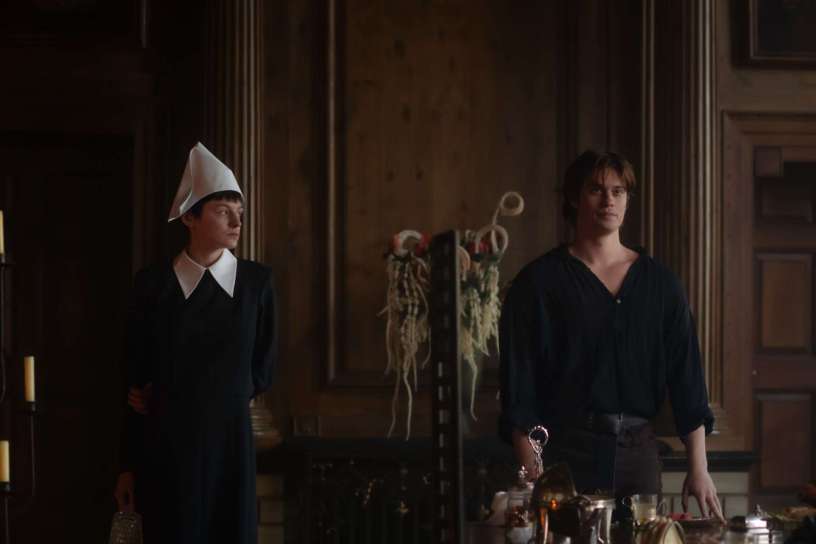
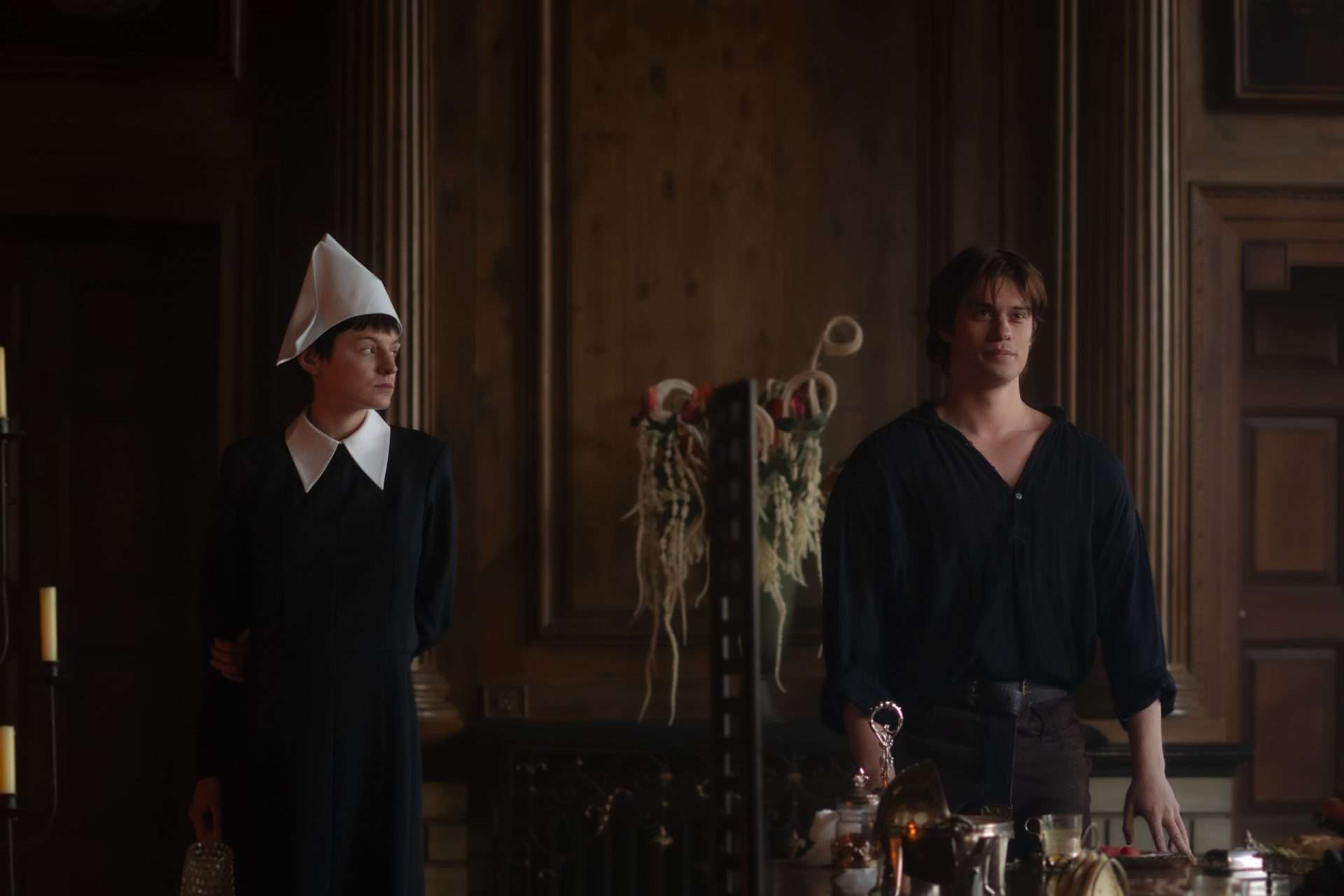
It’s all rather one note, a problem of both the script and the performances, which are uniformly uninteresting with the exception of Richard E Grant who is fun but also in this for literally less than 30 seconds (Felicity Jones, despite some prominence in the marketing, gets similarly short shrift). Though their costumes and make-up are great – everyone looking a bit vampiric – Monroe, Corrin, and Galitzine play this weirdness far too straight, with very little in the way of memorable bits of performance (Charli XCX, in one of her first acting roles, is given too little to do to make an impression one way or another).
As an ambitious fantasy satire that also made for an intriguingly mysterious choice for the closing night film of this year’s London Film Festival, I really wanted to like 100 Nights Of Hero and there is some stuff here to enjoy. But, as an overall package, it’s too empty to make any sort of real emotional impact, positive or negative, with its vague stabs at female empowerment and desire having been done far better and with far more force elsewhere.
 Jack Blackwell – Film Reviews