
Though he’s never been a slacker, despite clearly loving and respecting all those who dedicate themselves to goofing off, Richard Linklater has been working at double time for 2025, having two separate biopics premiering at this year’s London Film Festival before they release in cinemas within two months of one another. First up here is Blue Moon, the melancholic tale of songwriter Lorenz Hart (with Jean-Luc Godard bio Nouvelle Vague due out in January), a fittingly stagy piece for a titan of mid-20th Century American musical theatre that makes for a great showcase for Ethan Hawke without ever *quite* being compelling cinema itself.
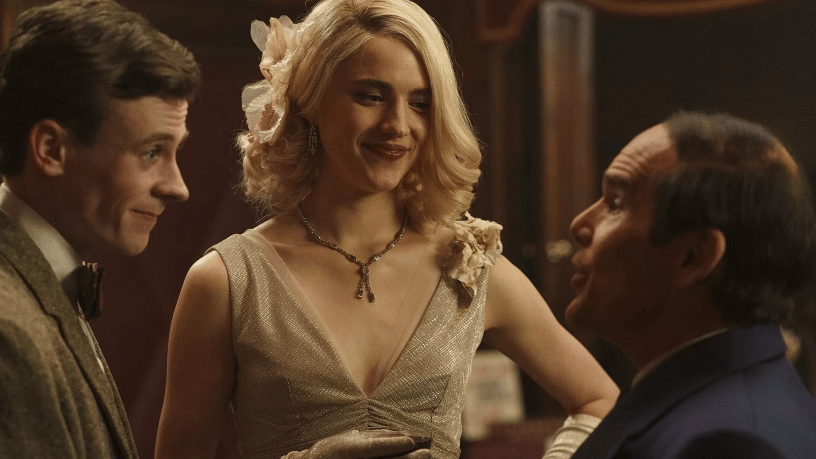
With Hawke as the motormouthed, tragic, and tiny (there’s a lot of powerful make-up work and camera trickery to turn Hawke into a small and frumpy man) Hart, Linklater has most of Blue Moon play out in basically real time and just one location in a showbiz-y New York bar. It’s 1943, and Oklahoma! has just premiered to rave reviews and guaranteed huge popular and financial success, signalling the start of the famous Rodgers and Hammerstein partnership and the end of the Rodgers and Hart one. Across the night, Hart commiserates with friendly and familiar bartender Eddie (Bobby Cannavale), acts happy for Rodgers (Andrew Scott) at his premiere party, and tries to impress the young student Elizabeth Weiland (Margaret Qualley) with whom he has fallen madly in love, but who herself, of course, only sees Hart as a mentor and friend.
It’s the correspondence letters between Hart and Weiland that serve as the initial basis for Robert Kaplow’s quickfire script, which zips between industry bitching, witty innuendo, and very sad musings on the lonely human condition, all three of which are comfortable subjects for Hart. He basically never stops talking, giving Hawke a hell of a lot to do and it’s a task he rises to with gusto. Oddly enough, it was Scott as Rodgers who got the acting plaudits when Blue Moon first premiered 9 months ago at Berlin, but if there’s anything it will be truly remembered for, it’s Hawke.
He’s funny and annoying and so damn sad (as a flash-forward prologue tells us, Hart will drink himself to death within seven months of the events we see here), never more majestically miserable than in an excruciating sequence in which he asks Elizabeth to describe her sexual escapades with her young, handsome classmates. It’s a moment so steeped in such a specific brand of patheticness that I found myself still sad about it after I’d got home from the cinema.
Outside of this, though, Blue Moon gets very repetitive – Hart’s first, second, tenth, and final conversations with all the other bar patrons/party attendees all basically the same, while Linklater’s muted style stops it from ever feeling particularly cinematic. With one location, a small cast, and a story that will undoubtedly be most effective for proper theatre nerds, it rather fails to convincingly answer the question of why this is a film rather than a play of its own. Then again, maybe ‘get Ethan Hawke his fifth Oscar nomination’ is reason enough – there’s little doubt he’d deserve it.
 Jack Blackwell – Film Reviews