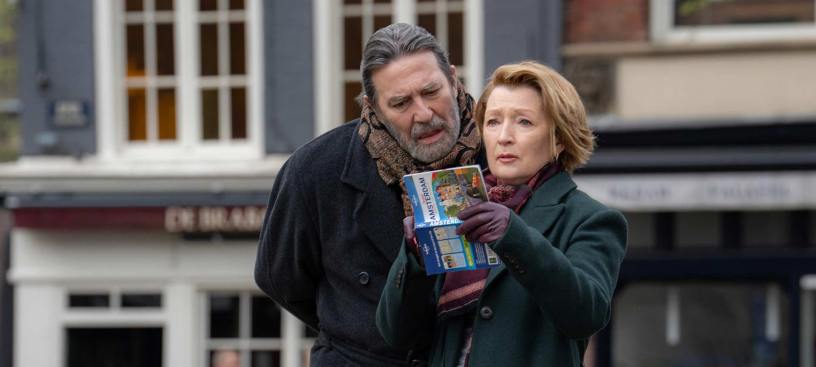
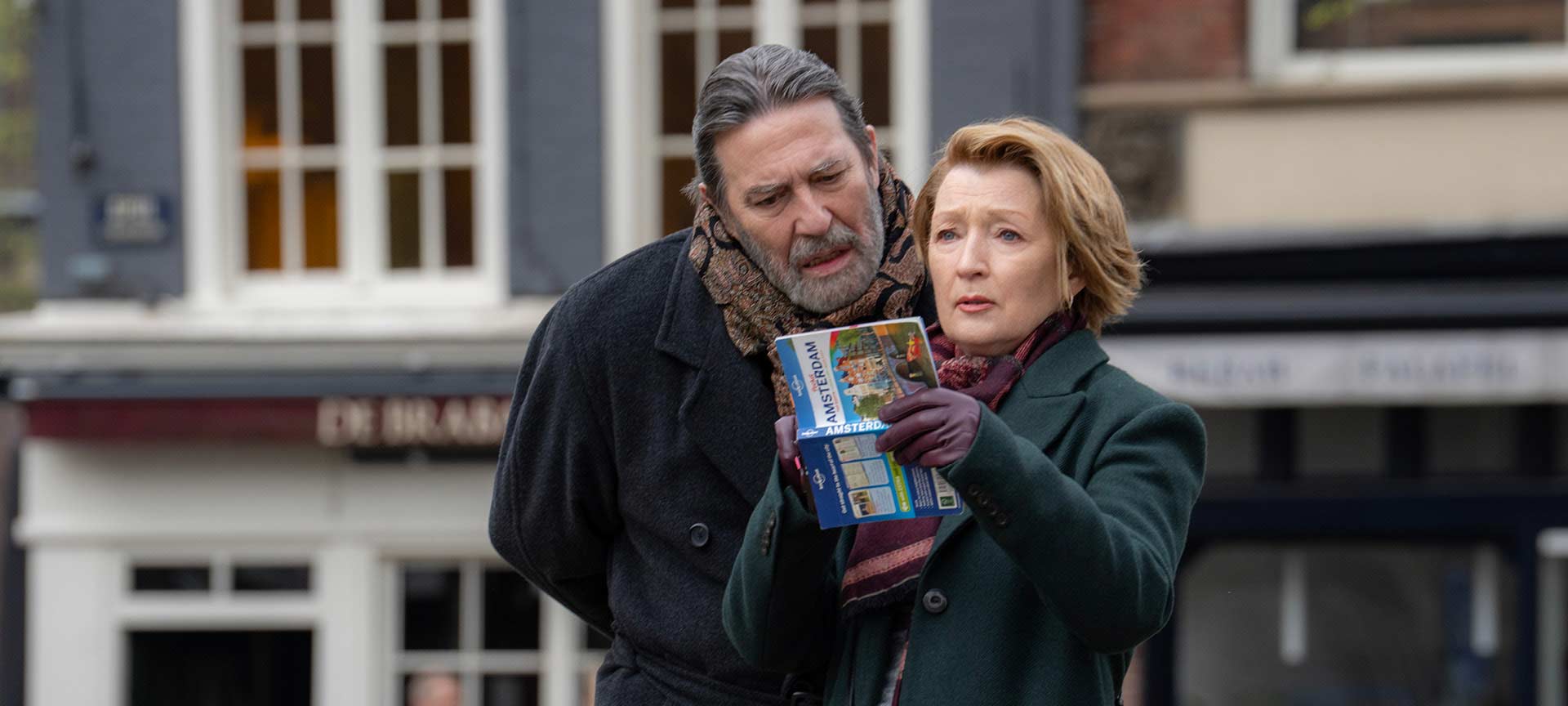
Celebrated theatre director Polly Findlay makes her cinematic debut with Midwinter Break, a small, contained drama adapted from the novel by Bernard MacLaverty that, despite its limited ambitions, manages to avoid the staginess that can typically accompany theatre directors stepping behind a camera for the first time. A low-key study of faith, marriage, and a three-quarter-life crisis, it might have a rather muted impact, but two strong performances from Lesley Manville and Ciaran Hinds at its heart, as well some lovely lighting work, make it a successful transition for Findlay from the stage to the screen.
With MacLaverty himself, alongside co-writer Nick Payne, on screenplay duties, Midwinter Break has Manville and Hinds as Stella and Gerry, a long-married couple who moved from Belfast to Glasgow decades ago after a heavily pregnant Stella got caught up as collateral damage in sectarian violence. Feeling an ever-growing distance between them (Findlay and co sketch out a very sad Christmas Day in particular), Stella books an impulsive trip to Amsterdam, which ends up only making things worse. Already divided by Stella’s devout Catholicism and Gerry’s total atheism, an argument in a church about Gerry’s need to dismiss Stella’s faith snowballs into a marriage-imploding crisis.
Midwinter Break doesn’t ask you to take sides, Manville and Hinds each giving deeply believable performances as two people who are becoming irreconcilably different rather than outright opposed. Gerry is a deeply flawed husband, his drinking, interrupting, and inability to let a moment go without a deflating joke not drastic in and of themselves, but clearly adding up to more than enough to kill a connection. Yet, as Stella suddenly tries to apply to live in a convent that hasn’t actually contained nuns since 1971, it becomes clear she’s having some sort of additional, more irrational breakdown – a reverse crisis of faith where her problem is that she hasn’t put *enough* blind trust in her God.
It’s all expressed in solid but unremarkable dialogue, the ideas being explored typically more interesting than the words being used to explore them, which can feel pretty generic at times, particularly during the arguments, which end up in the same gentle good taste register as the more easygoing moments. Findlay does shoot them very nicely though, with the contrast between the crisp grey Dutch January sky of the exteriors and the Dutch Masters-aping golden, contrast-heavy, painterly look of the interiors consistently very effective.
At a brisk 90 minutes, Midwinter Break knows how to not overstay its welcome, and there’s a very good chance that older or married or more religious people than me will find a lot more to cling onto here than I did. As it stands for me, this is a solid little drama that rises above the whole ‘Sunday-night-on-ITV’ vibes it very much could have had, even if I’m unlikely to spend much time dwelling on it in the days to come.
 Jack Blackwell – Film Reviews