
In a multitude of ways, The Life of Chuck begins at the end. The very first thing we see is a title card saying ‘Act Three’, a precursor to a segment in this distinctly three-part story that tackles both the slipping into death of a terminally ill man and the end of Earth, perhaps reality, itself. It’s an immediately interesting structural conceit that is then wasted on a film that, outside of this non-linear trickery, is flat and obvious, a movie desperate to be a weepie that, somehow, has no real idea how to make you cry.
Adapting the short story by Stephen King, writer-director Mike Flanagan moves from the terrifying yet empathetic horrors that made his name on Netflix into something simultaneously a lot more schmaltzy but also harder to classify. Structured in three acts, told in reverse order, we see the death, adulthood, and finally the childhood of Chuck Krantz (Tom Hiddleston as an adult, Jacob Tremblay and Benjamin Pajak in various childhood phases), an accountant with an artist’s soul whose life has taken some tragic turns. In the opening-yet-final act, though, we barely see him (Hiddleston is not actually, despite being the top-billed star and the title character, in a huge amount of the whole film), instead focusing on a pair of star-crossed ex-lovers as they reunite to face the apocalypse.
These are teacher Marty (Chiwetel Ejiofor) and nurse Felicity (Karen Gillan), our eyes for a world in freefall as Biblical-scale natural disasters ravage Earth while the face of Chuck starts appearing everywhere, from billboards to TV ads to skywriting, always accompanied by a mysterious message. It’s a smart segment to start with, Flanagan’s directorial knack for the scary turning it into a very eerie and visually intriguing apocalypse, a vital antidote to an awful script.
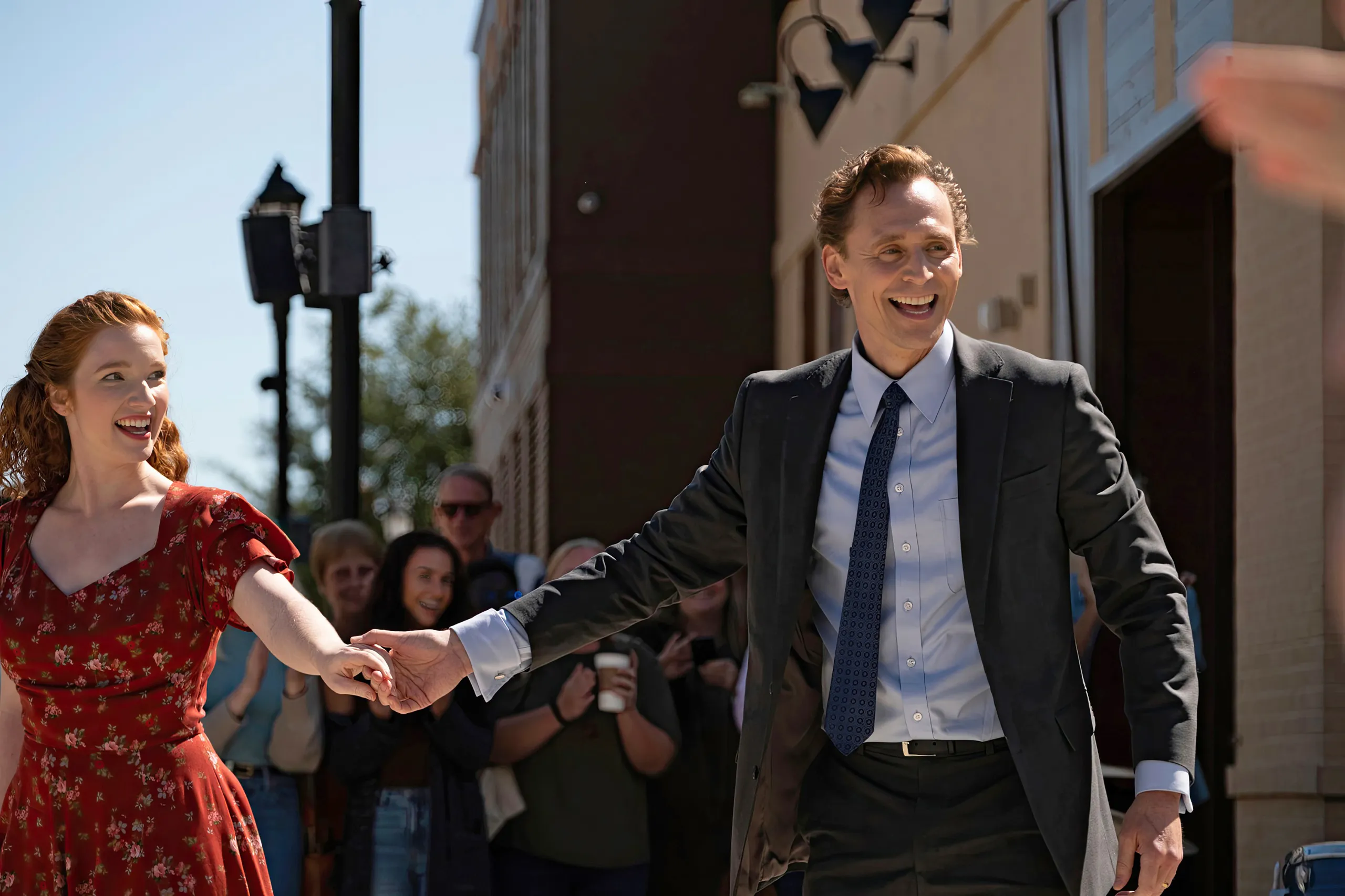
The other segments don’t have this creepy end-of-days mystery (the eventual answer to which is pretty disappointing) to pick up the slack and, despite some genuinely lovely dance sequences to punctuate the crummy dialogue, suffer immensely because of it. Everyone here speaks in either artless exposition, saccharine pablum, or faux profundities about mankind’s place in the cosmos, all peppered with some very forced-feeling Funny Swearing, and none of the actors can break through to make any of it sound convincingly *human*. Some of this is down to Hiddleston and Gillan rather struggling through their American accents, but the US roster – including Mark Hamill, Carl Lumbly, and Nick Offerman (as the narrator) – don’t really do any better.
Stuff that might have worked on the page in King’s original story feels painfully overwrought when brought to the screen, all leading up to climactic moments where Flanagan all but puts up a neon sign saying ‘please cry now’. The Life of Chuck has its moments of magic and, for all the generic dialogue, this isn’t quite a film you’ve ever seen before, which is no small feat, but there’s a gaping chasm where its real human heart should be.
 Jack Blackwell – Film Reviews
Hey Jack, I really enjoyed your in-depth review of The Life of Chuck. You highlighted how the film’s unique reverse, three-act structure starts at the end and works backward through Chuck’s life, tackling themes of death and apocalypse. I also appreciated your points about the film’s strong visual atmosphere in the opening act, contrasted with dialogue and performances that sometimes felt forced or overly sentimental.
As a fan of Mike Flanagan, I really appreciate how The Life of Chuck showcases his willingness to push boundaries and experiment with storytelling. The reverse, three-act structure is a bold and original approach that adds a unique flavor to the film and keeps you engaged trying to piece things together.
Flanagan’s talent for creating atmosphere really shines in the apocalyptic opening act—it’s eerie and visually striking, a reminder of his strengths in crafting tension and mood. While some of the dialogue felt a bit on the nose or overly sentimental at times, I think the emotional core was still there, especially through the performances from Ejiofor and Hiddleston, who bring subtlety and depth despite the challenges in the script.
I noticed you mentioned the “neon sign” moments where the film seems to demand tears—do you think Flanagan’s usual subtlety in building emotion was compromised here? Also, how did you feel about the casting choices and the actors’ performances, especially regarding the American accents? Do you think the film’s blend of sci-fi apocalypse and intimate personal story worked effectively, or did it feel uneven?
Overall, The Life of Chuck might not hit every note perfectly, but it’s an intriguing and ambitious film that demonstrates Flanagan’s growth as a storyteller. I’m curious to hear your thoughts on whether this film signals a new direction for him or if you’d prefer he return to his horror roots.