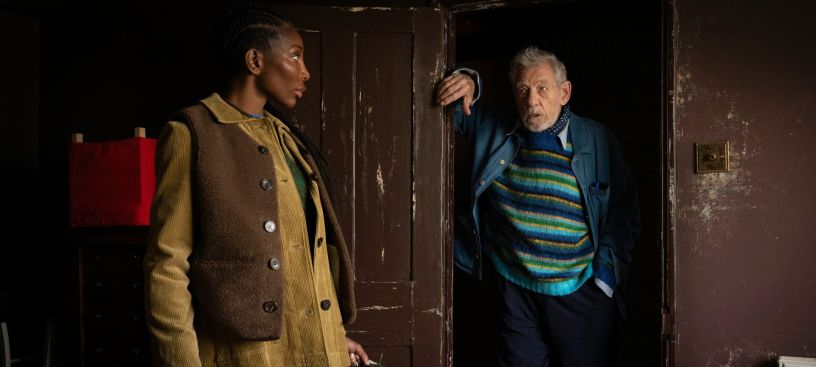
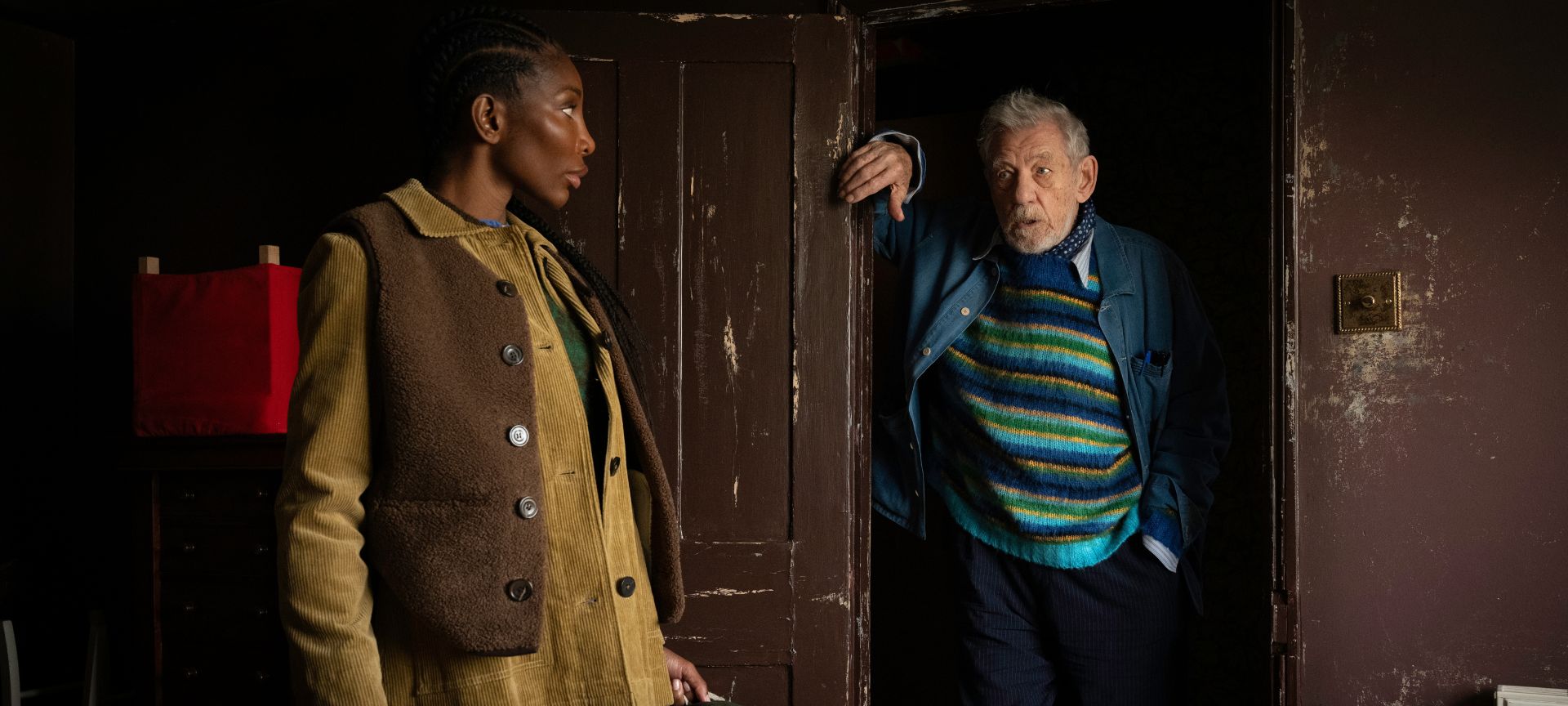
Steven Soderbergh continues his stint as Hollywood’s most prolific and chameleonic ‘retiree’ with The Christophers, hitting UK screens barely a year after his spy drama Black Bag and at the same time as his very ill-received AI-powered John Lennon documentary is premiering at this year’s edition of Cannes. A stagy and very English two-hander, it’s another genre shift for Soderbergh after a thriller-heavy couple of years, a slowing down of sorts that ends up unable to settle on a new pace, a witty and barbed script from Ed Solomon brought to life in a more subdued manner than it really needed by a surprisingly sedate pair of performances from Ian McKellen and Michaela Coel.
Set mostly in the two adjoining town houses owned by once-infamous artist Julian Sklar (McKellen, of course), The Christophers initially seems to be offering a sort of quasi-heist story before transforming into something with a smaller scale and lower stakes. Coel plays Lori Butler, an art restorer and sometimes forger who gets hired by Sklar’s grasping children Sallie (Jessica Gunning) and Barnaby (James Corden) to pose as their ageing dad’s new assistant in order to get access to his locked attic and fraudulently finish his incomplete ‘Christophers’, a series of portraits of one of Julian’s ex-lovers.
Soderbergh and Solomon clearly aren’t all that interested in the scheming of it all, staying far away from any sort of thriller territory, but the problem is then identifying what in this story *does* interest them. There’s a sort of growing surrogate father-daughter thing happening between Julian and Lori as well as all the obligatory ‘modern artists are whingy and rubbish’ stuff, but nothing is committed to strongly enough to serve as a driving force. McKellen certainly gets some funny lines, and Julian is never reduced to just the ‘cantankerous old man’ archetype that can plague stories like this, but there’s simply not enough to hang on to here, especially once we get into a bizarrely saccharine climax.
It’s a problem that mainly arises out of the fact that no-one involved seems to be working to the same rhythm – Solomon’s dialogue is cutting and quick on the page but McKellen and, especially, Coel really take their time chewing over it, smoothing down those sharp edges in the process. The result is a pair of performances that seem disconnected from the film around them, a pity when you’ve got such a theoretically heavy-hitting lead duo.
Stylistically, The Christophers is as unfussy as we’ve come to expect from late-period Soderbergh, scenes lit entirely diegetically and backed by a minimal soundscape. There are some great little cuts and mini-sequences here and there (Soderbergh again pseudonymously edits the film himself) that let us really explore both Julian’s ritzy yet cluttered Fitzrovia fortress and the hip art collective space that Lori calls home, but that’s as flashy as things get. There’s nothing inherently wrong with this slightly anonymous approach but, when matched with the acting-script disconnect, feeds into a feeling that The Christophers was directed with just one eye, while the other looked to the next project on Soderbergh’s inexhaustible pile.

