
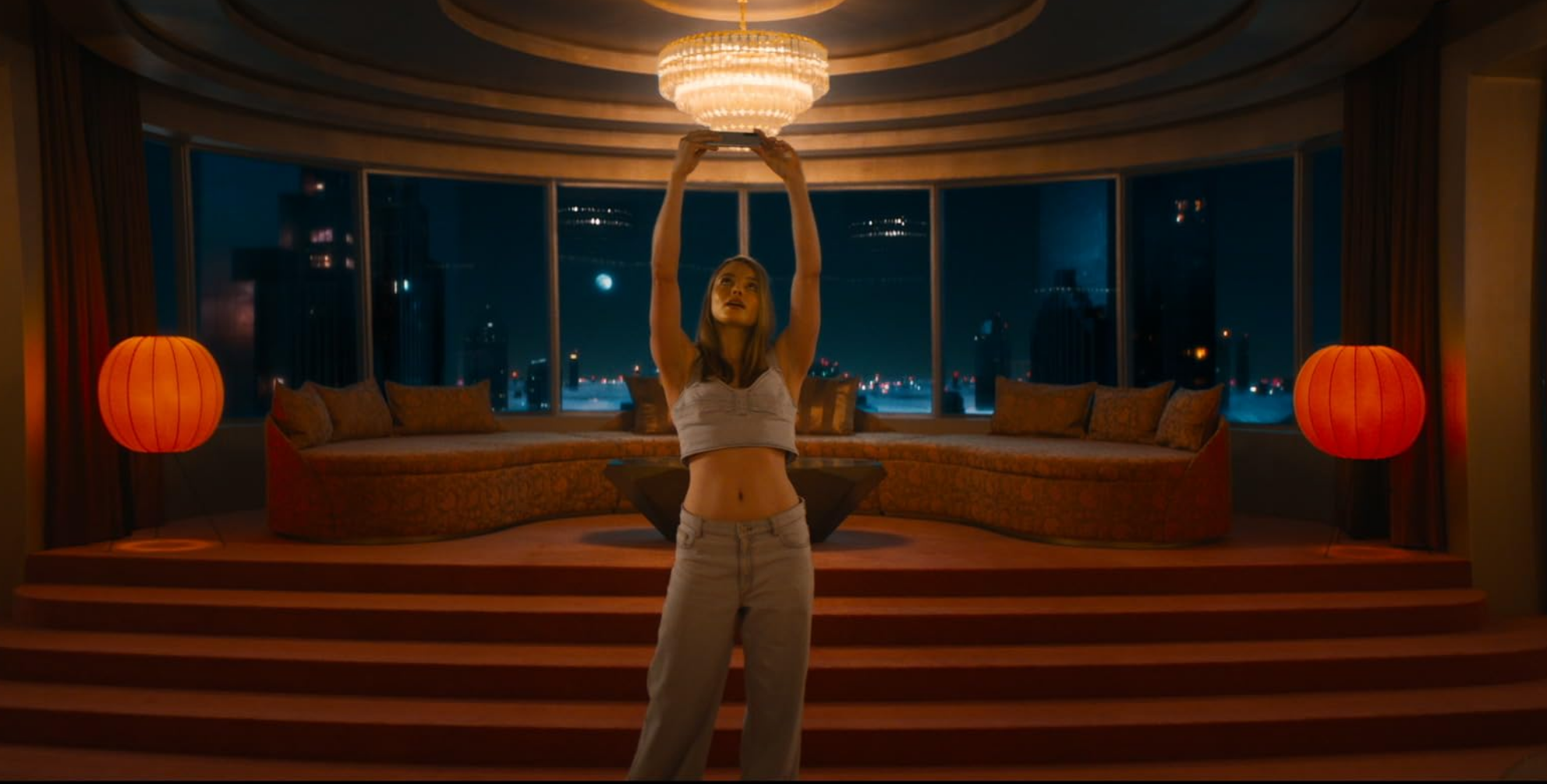
Stop me if you’ve heard this one before: Nicolas Winding Refn’s new film is set in a neon-drenched, hellish mirror version of the entertainment industry, where young and beautiful waifish women wear shimmering outfits and are menaced by something on the border between real and nightmare. So far, so The Neon Demon, and it is perhaps the most disappointing thing about Her Private Hell that it doesn’t have anything actually *new* to add to Refn’s oeuvre after a full decade gap between films. As with all his work, it’s still beautiful, still dreamily atmospheric, but so empty that even I, an ardent defender of all his previous self-indulgent work, couldn’t cross the gap into actually caring about any of it.
If there is something novel to be found here, it’s in just how far the world Refn creates here is removed from reality. Only God Forgives and The Neon Demon were bizarre, but took place in an identifiable location. Her Private Hell finally sees him go all out and create a genuine parallel Refn-world. There are some flashbacks (or flash-sidewayses?) to post-war Japan, but Refn and co-writer Esti Giordani keep these subplots seemingly operating on a different plane of existence, characters connected in spirit but not physically.
For the nowhere-world, made up of giant, glittering-yet-liminal skyscrapers and a mist-shrouded, permanently midnight city below, our guide is Elle (Sophie Thatcher) an actress currently shooting a Barbarella-esque sci-fi movie that seems just as inscrutable as Her Private Hell itself. She’s haunted by tales of the Leather Man, a supernaturally strong serial killer, but also dealing with the more personal crises of having to deal with vapid co-star Hunter (Kristine Froseth) and the fact that her ex-best friend Dominique (Havana Rose Liu) is now her stepmother after marrying her creepy dad. How seriously you’re meant to take any of this is up for debate, but the dad *is* called Johnny Thunders, so a full po-face might not be Refn’s intention.
Parallel to Elle is Private K (Charles Melton), an American GI searching for his missing daughter in what looks like 1950s Japan, getting in violent trouble with both the Yakuza and the local police force. All the classic Refn ingredients are here then: neon glow lighting, bursts of nasty violence, disturbing malfunctions of sexuality, and a fetishisation of everything, from Asian women to old-school lighters, but they seem to add up to less than ever.
A big part of this is that none of the plot I just mentioned, which does take some explaining, actually really matters at all. The stakes here are minimal-to-none, these characters so far removed from being recognisable people that they may as well be aliens, and so moments where we suddenly are meant to feel tension or pity or relief for them just fall completely flat. You don’t need realistic dialogue or ‘normal’ characters to create something great – just look at most of Yorgos Lanthimos’s work, for example – but if you’re going to alienate your audience to this degree, you need to give them something else to cling on to, even if that something is simply shock value.
And it’s here where a lesser, though actually more interesting, problem lies with Her Private Hell – by Refn standards, the excesses here are actually a little tame (how it’s been saddled with a full 18 BBFC rating is honestly baffling to me). The violence here is less gory and wince-inducing than anything in Only God Forgives or even really Drive, the sexuality both less explicit and less upsetting than The Neon Demon, and the plot itself far less able to provoke than his underrated TV series Too Old To Die Young. Combine this softer touch with the disinterest this script has in its own characters, and you’ve got something hard to latch on to and, in maybe a first for Refn, something that might even be actively forgettable.
Holding the line, then, is his trademark style, and it’s in this that I can’t fully dismiss Her Private Hell. Every piece of design work, from the sets to the costumes to the makeup, every pop of rich light and dense mist, every composition – it all looks absolutely wondrous. The music is sublime too, unnervingly twinkly; Refn has always combined his hypermodern aesthetics with a more fairytale sensibility and the score here is that technique pushed into magical new heights. If you have loved his work in the past, his formal daring remains here and is hard to discount, but that’s all there is to love here. In a moment of petty cruelty, Elle dismisses Hunter by asking ‘how can someone so hot be so unfuckable?’, a sentence that actually perfectly encapsulates the film they’re both in – aesthetically impeccable but utterly body-less.

