
Though it is as grandiose and gorgeous as all the early word promised, one of the main things I couldn’t stop thinking about while watching La Bola Negra, the film debut of TV directing duo Javier Ambrossi and Javier Calvo (aka Los Javis), was what an unusual and ambitious act of *adaptation* it is. Adapting and expanding the lost/unfinished play of the same name by murdered gay socialist playwright Federico Lorca, it also spends a lot of its runtime being *about* that very same play and how it haunts and echoes through its characters. The result is an epic that is both big-hearted and intellectually distant, often cryptic and removed but, in moments where it lets you in or you finally find yourself at one with its rhythms, immensely rewarding.
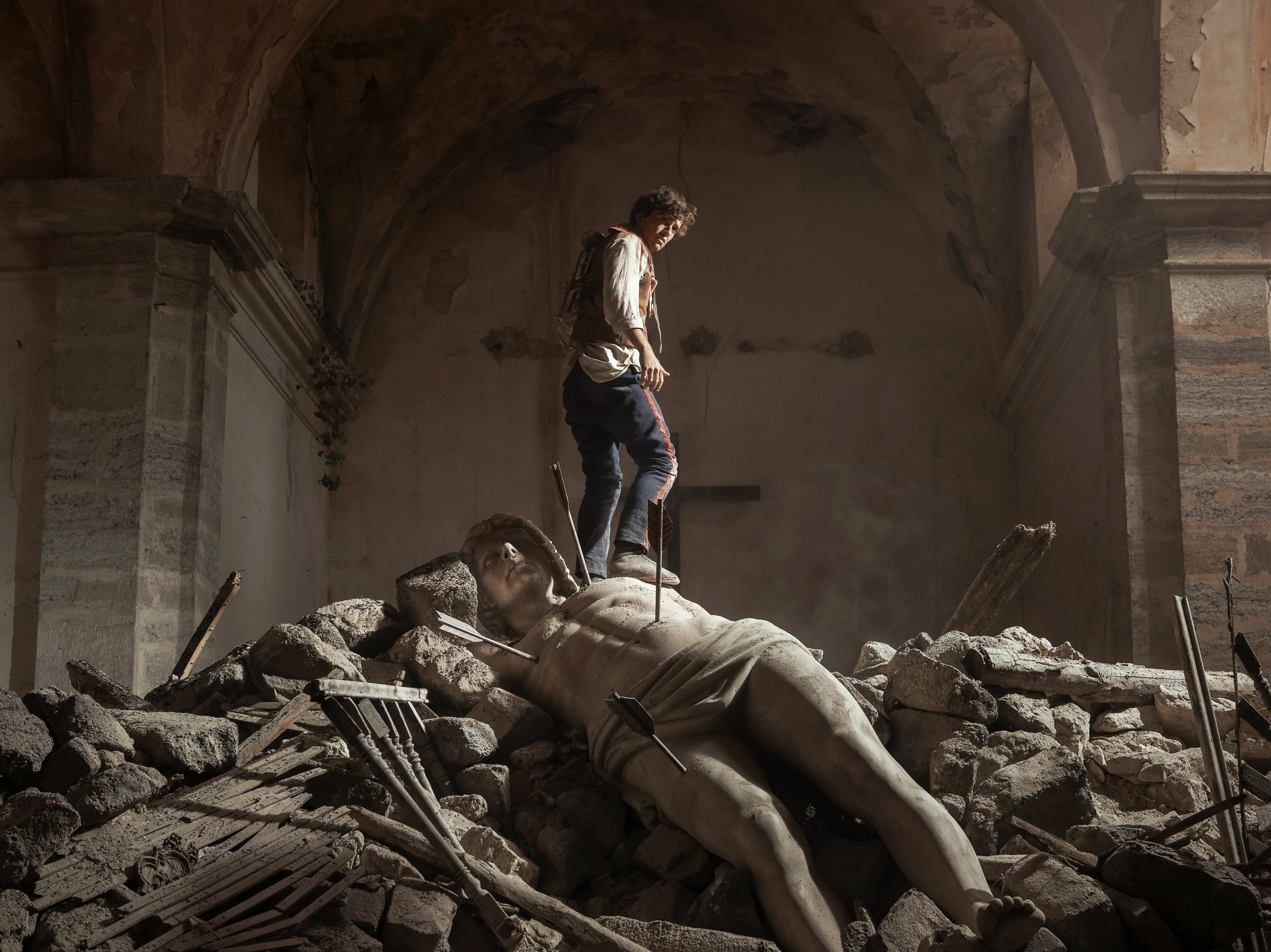
Following three gay Spanish men in three different time periods, La Bola Negra takes us to 1932, 1937, and 2017, constantly cutting back and forth in time, which can make the first 15-20 minutes feel rather chaotic until you get used to it. Of these, the middle child is actually first among equals. It’s the most straightforward and moving story, as we follow Sebastian (musician and first-time actor Guitarricadelafuente), a naïve and musically un-gifted trumpet player who accidentally falls in with the Fascist army during the Spanish Civil War before slowly falling in love with beautiful Communist prisoner Rafael (Miguel Bernardeau).
In 1932 – which eventually is revealed to be the actual adaptation (and invented expansion) of the original La Bola Negra play – we’re with Carlos (Milo Quifes), a young man blackballed from membership at the local casino due to his suspected homosexuality, all while revolutionary fervour sweeps the streets. This section is La Bola Negra at its most mysterious, all symbolism and heightened reality to examine both the specifics and universalities of the cruelties defining young gay men’s lives. Sometimes it’s a bit too unknowable for its own good, but it also contains some jaw-dropping set-pieces, like a dance at a bar that melds the worlds of reality and fantasy and a hike up an icy mountain surrounded by rapidly descending skiers.
2017, somewhat inevitably, is the least grand, following music historian Alberto (Carlos Gonzalez) as he deals with his chaotic, perpetually furious mum after receiving an inheritance from his estranged grandfather that turns out to be Lorca’s full La Bola Negra manuscript. La Bola Negra is mostly at its best at its most show-off-y, and it’s the historical portions that lend themselves best to that, but Alberto provides fascinating contrasts with his ‘ancestors’. His mum hates him, partly for his open gayness, while the women in Carlos and Sebastian’s lives, who know about their homosexuality in a more unspoken way, are much kinder and more patient. Alberto can hook up any time he likes (his segment is opened by a Grindr notification), but the sex he has holds far less importance than a brush of the knee back in 1937.
Ambrossi and Calvi are fascinated by their own characters’ search for meaning, which makes La Bola Negra an intellectual exercise as much as an emotional one, and there are lulls here and there where the cleverness becomes a point unto itself. Yet, just when you think they might be losing their grip, they hit you with something deeply affecting or visually staggering and you’re hypnotised all over again.
From an early bombing raid on a village to various trips to the beach at dusk, dawn, and in moonlight to a spectacular song-and-dance number from Penelope Cruz in a fun cameo as burlesque dancer Nene Romero, there’s plenty to be *amazed* by here. ‘Sweeping’ seems to be the most important stylistic note here, and that’s reflected in gorgeous set and costume designs, technically demanding camera moves, chaotic and well-populated crowd scenes, and lovely music. La Bola Negra is one of the few films that bookies have as a possible Odyssey-beater at next year’s Oscars, and whilst this obviously can’t match Nolan-level scale, to have two proper epics duking it out for cinema’s top prize is a great thing.
At 160 minutes, perhaps La Bola Negra’s greatest achievement is that, despite all its timeline shenanigans and moments of slow consideration, you don’t really feel that length. From the moment it premiered at Cannes, two words have defined its marketing – ‘queer’ and ‘epic’ – and it delivers on both those promises in spades, doomed love echoing through the decades, refracted by one of Europe’s most unique 20th Century histories of repressive ‘peace’ that formed a steel wall against progress.

