Much like The Drama earlier this year, the marketing for Olivia Wilde’s latest directorial effort The Invite has decided to play it coy about what this comedy of manners between two sets of neighbours is *really* about. Unlike The Drama, though, the marketing has done a very bad job of it – if you couldn’t guess that the ‘twist’ is that one of the couples is into swinging you’d have had to have watched the trailers half-asleep and looking at your phone. Thankfully, though, the film itself is much less concerned with trying to surprise you, escalating this tale of ‘prudes vs perverts’ in ways that always feel natural and almost always get laughs.
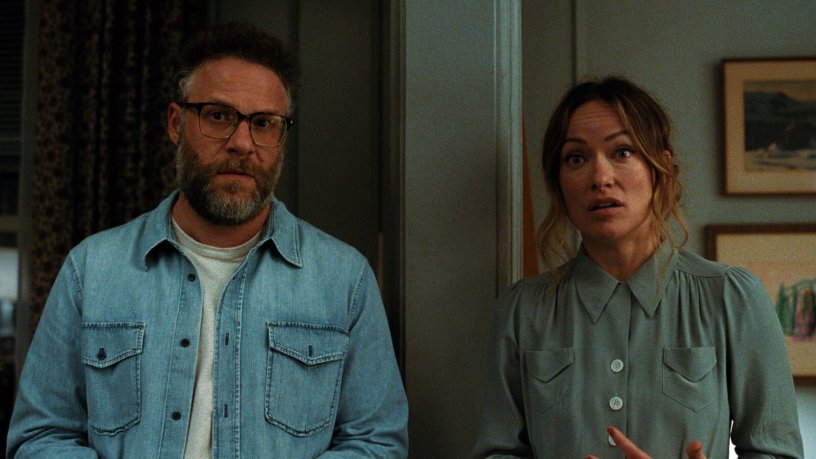
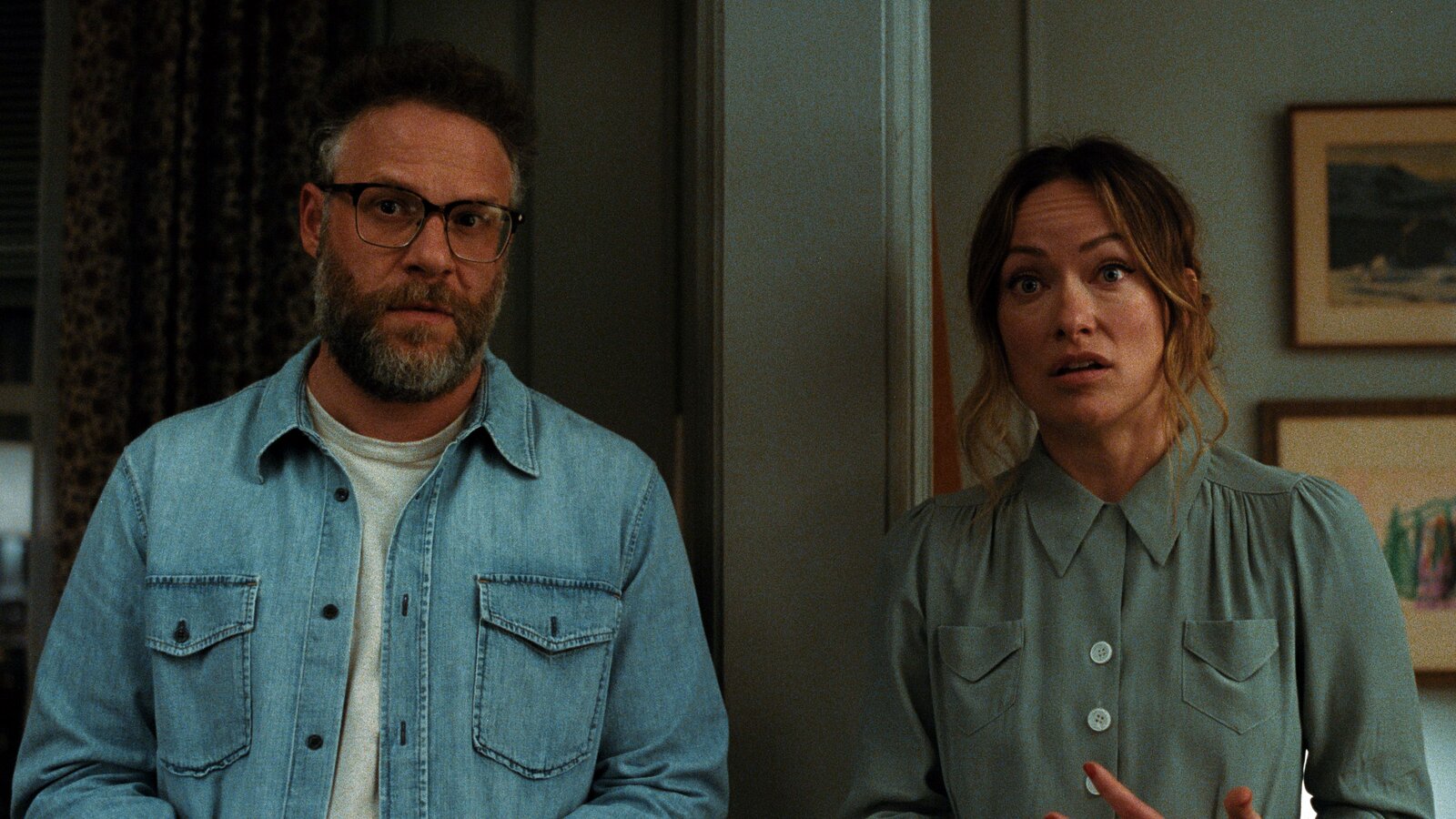
A remake of Spanish film The People Upstairs, The Invite plays out as a claustrophobic farce. We almost never leave the nice San Francisco apartment of Joe (Seth Rogen) and Angela (Wilde herself) as they host their slightly older, considerably more easy-going upstairs neighbours Hawk (Edward Norton) and Pina (Penelope Cruz) for an evening of wine, cheese, and charcuterie. Joe and Angela are at each other’s throats immediately; Angela planned this last minute without any of Joe’s input and so he’s going to spitefully use this unwanted visitation to confront Hawk and Pina about the thunderously loud sex they’ve been having right on top of Joe and Angela’s heads.
It’s this agenda that fuels almost all of The Invite. For Joe and Angela, it’s not just about the noise, it’s the reminder of the sex they’re *not* having with one another, and Hawk and Pina swiftly guess what Joe wants to confront them about, even as Angela keeps trying to silence him. As the conversation drifts that way, boundaries start getting pushed and suggestions start getting made, with the end goal of a possible orgy starting to stick in everyone’s minds.
If that sounds like it would be squirmingly uncomfortable on paper, it’s even more so in practice. Rashida Jones and Will McCormack’s script revels in the cringe comedy of bringing together two people who are perpetually embarrassed with another two who simply cannot be shamed and use that as a social superpower. It’s sharp and funny and incredibly verbose, filled with chaotic scenes of characters talking at and over one another for minutes at a time, a bit reminiscent of the whirlwind dialogue sequences of the Safdies, though the stakes are a lot lower and the people a lot more agreeable here. The final few scenes grab too strongly at an earnestness that doesn’t quite feel of a piece with the previous 90-odd minutes, but this is, overall, a very well-drawn and funny quartet of characters.
It’s the kind of semi-stagy script that actors revel in, and Rogen, Cruz, and, especially, Norton really do make the most of it. Rogen effortlessly sheds his usual likeable schlub persona to get somewhere darker and meaner, Cruz turns Pina’s sexuality from an invite into a weapon on a dime, while Norton basically steals the whole show with almost all of the funniest line deliveries and a sublime late-breaking monologue. Wilde herself, though, goes a bit too broad, Angela always played in a more hysterical register than any of the other characters. She’s still funny and compelling (the ways Angela simply moves through the apartment are frequently and amusingly ludicrous), but Wilde the director fails to get a proper handle on Wilde the performer to keep her tonally in line with everyone else.
Shrinking the scope considerably after the very good-looking but otherwise rightfully ill-received grandiosities of Don’t Worry Darling, Wilde shoots the apartment very well. When things are going badly for the couples, her camerawork catches the rooms at uncomfortable angles where they stop looking particularly homely, but, in jollier moments, the spaces take on a warmth and intimacy, keeping this very contained single location consistently visually interesting. Come for the décor, stay for the caustic and funny sexual negotiations, and leave not sure whether you’re feeling catharsis or second-hand humiliation.

