
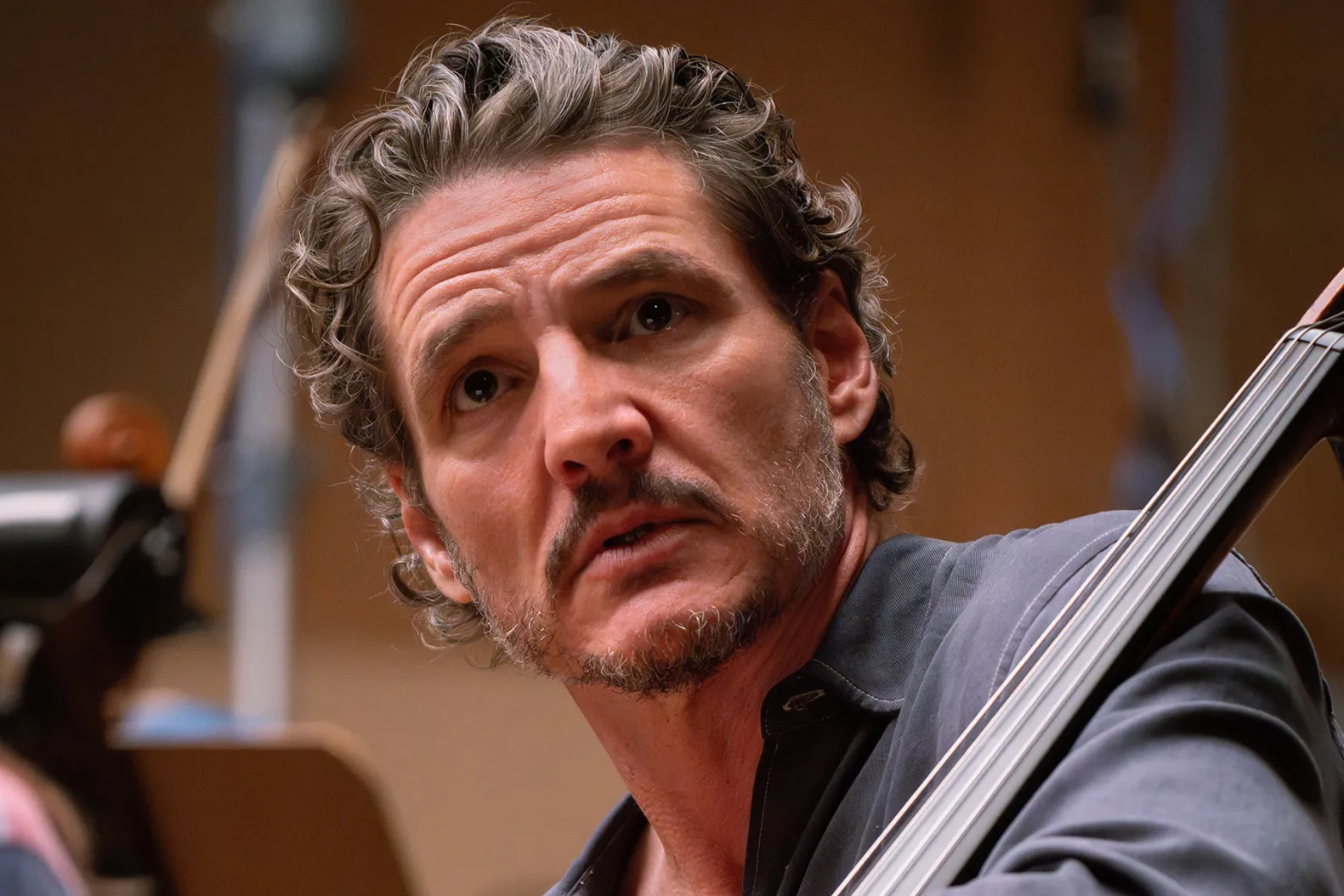
After gifting us with the best entry in the Star Wars universe since, well, 1977’s Star Wars, Andor showrunner Tony Gilroy has cashed in his studio reward chips in a rather odd manner with Behemoth. Make no mistake, despite glossy production values and the presence of the ubiquitous Pedro Pascal as the star, this is the sort of ‘one for me’ that filmmakers need to *earn*, a largely plotless collection of vignettes filled with unlikeable characters with stakes that only fully make sense if you’re familiar with both the film and classical music worlds. It’s an admirably bold swing from Gilroy, one that, fittingly, marches entirely to its own beat but also one with a slightly hollow centre when all is said and done.
Pascal plays the fantastically well-named Alex Serian, a Casanova cellist who can be assured of a place in an orchestra, not to mention a warm bed, in pretty much any major city in America. We start with him in present-day LA, his arrival sudden and rather unplanned, running away from and towards a bevy of competing interests all at once, but frequently flash back across his career – 2010 in Dallas, 2016 back in LA, and just a few weeks ago in Chicago. There’s a lot of energy in flashing through the years and some great styling of Pascal makes each era easily identifiable thanks to, mostly, Alex’s changing hairstyles.
While Alex is dealing with a lot – his mother is dying of dementia, his brother Andy (Will Arnett) is having a midlife crisis, his romantic entanglements are still getting the better of him, and the local 15 year old music prodigy might be his illegitimate daughter – Behemoth rarely ties these things together into a straightforward plot. It does give an enjoyably freewheeling feel to things, but also stunts Behemoth emotionally, its big climactic moments landing a bit softly.
Then again, that is partly the point. Behemoth is an *incredibly* subjective film; there isn’t a moment where we aren’t fully within Alex’s perspective, forced to see the world as he does, and he’s a pretty emotionally stunted guy (Pascal gets a great moment where Alex laughs his way through an anecdote that is, in fact, profoundly traumatic). It means we get to know Alex incredibly well but, aside from Andy, everyone else is, by design, a bit two-dimensional. This is most notable in Alex’s two most prominent exes; similarly gifted violinist Nadia (Eva Victor), and insane multimillionaire socialite Carol (Olivia Wilde).
Alex himself cannot really conceptualise these women’s inner lives, so we also don’t get the chance to. It’s a risky choice, one that could read as sexist, but is deployed with purpose, building problems out of Alex’s colossal blind spots and making it matter when he’s finally able to build some non-sexual relationships with younger women, their three-dimensionality affecting after the icily sexy mystery of Victor and Wilde. It’s one of a lot of little touches in which Gilroy’s writing is more clever than impactful, something you can really appreciate on an intellectual level without deeply feeling it. The hair and makeup and costuming do pick up some of the slack here, whether it’s Wilde using weaponised cleavage to really hammer home Carol’s take-no-prisoners rage or Arnett taking off a pair of glasses in such spectacularly douchey style that I might never forget it.
In fact, if Behemoth were just a little more joke-dense, it would play more like a TV comedy than a big, dramatic movie, and it’s this tension in which Gilroy finds his real comic engine. In 2026 LA, Alex’s gigs are for movie soundtracks rather than playing classical pieces, and so these grand, sweeping scores (the brief glimpses we get of the films, including the eponymous Behemoth look like Mission Impossible-esque spy thrillers) end up soundtracking his own life. Cutting back and forth between the studio and a past mistake/humiliation for Alex, we get epic strings and woodwinds accompanying some very stock sitcom-style scenarios – Alex has to hide from an ex, Alex pretends to be a waiter at a wedding after a mistaken identity and gets into shenanigans – which is consistently amusing.
Handsomely shot, shifting between a lot of locations, really stacking its scenes with busy-looking extras, and being filled with original orchestral compositions from nine separate celebrated composers, Behemoth makes the most of its modest-ish budget. It really is the kind of film ‘they don’t make anymore’, louche and grown up and contemporary (and also weird in its own specific ways) and so I’m glad this was how Gilroy spent his Andor goodwill. It might not all work, particularly when it wants to pull at the heartstrings, but I haven’t seen anything else quite like it – there are moments where it feels like James Bond just fell into a New Girl episode, and that’s a crossover more than worth exploring.

