
If you’re from the UK and under, say, 60, there’s a good chance that you’ve never had a political opinion that wasn’t, in some way, coloured by Rupert Murdoch. Whether it’s fervent agreement or vehement disagreement with the right-wing bile he’s made billions off of, or just a set of beliefs that naturally develop in the ambient Murdoch miasma that is our modern media environment, he is the great ‘thought leader’ of the last half-century. Or, as Danny Boyle’s Ink posits, maybe he’s not. Maybe all the blame needs to go to Larry Lamb, the editor of The Sun from 1969 until the ‘80s, who Ink follows as the man who Murdoch-ised Britain in an energetic but empty story that hedges its moral bets until it loses all real weight.
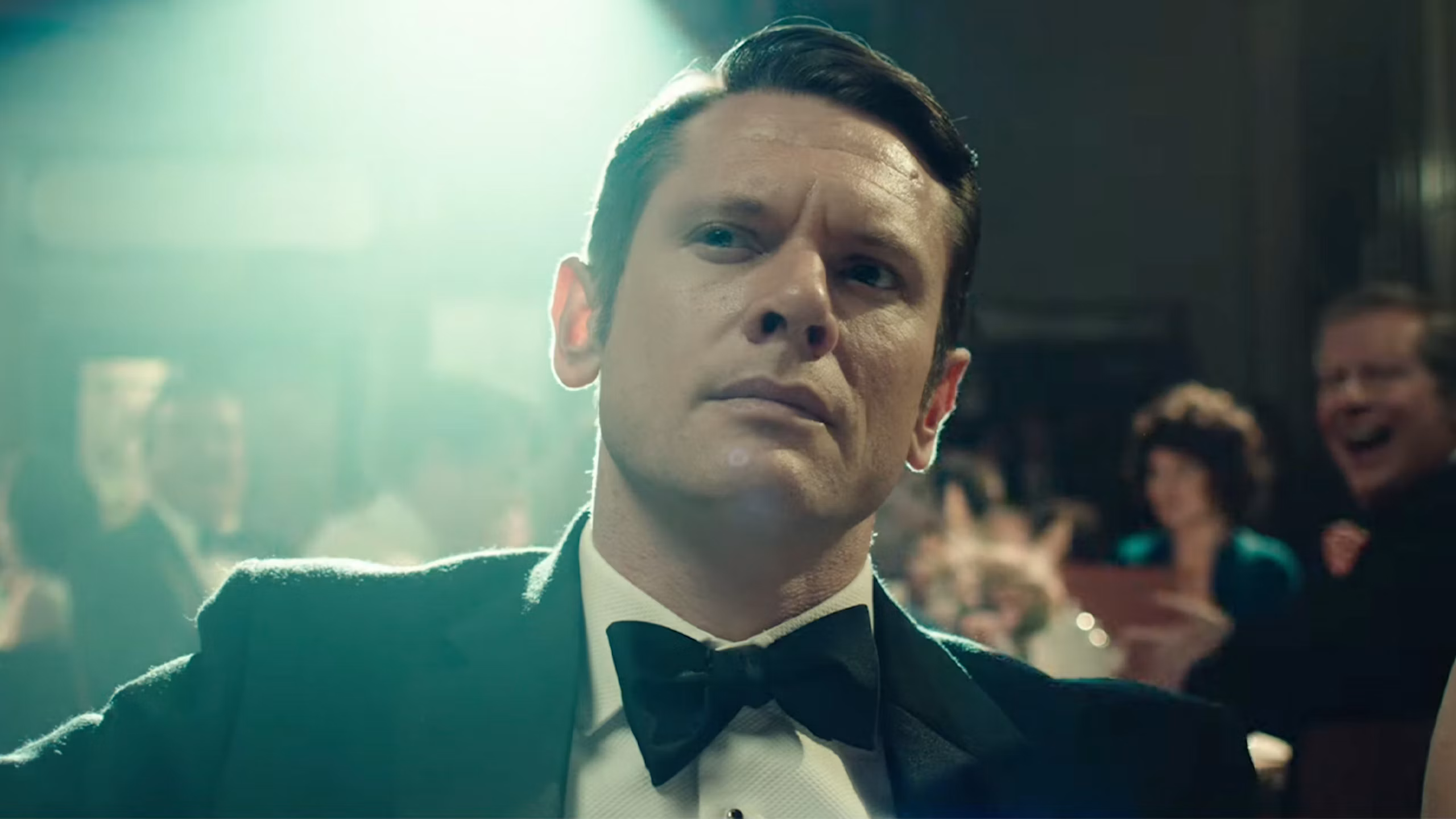
As played by Jack O’Connell, Lamb is our protagonist throughout Ink, with Guy Pearce’s Murdoch more of a background figure. We watch as Lamb, cast out from the in-crowd of Fleet Street, digs through all the bad-taste muck he can find until he’s running the most-sold newspaper in the country (eventually the entire world), fuelled by a savvy business sense and a spiteful need for vengeance against the stuffy upper-crust establishment.
It’s this fight against the crooked-toothed snobs of Fleet Street that Boyle and writer James Graham really focus on and it’s rarely an immensely compelling story on its own merits, hard to care about when the conclusion – that our ‘hero’ will win and is actually a world-historical villain – is foregone. This distance is also felt in the central performances (Claire Foy rounding out the trio as The Sun’s first Women’s Editor Jules Davies), which are solid but not spectacular, far from the best work of any of the lead three. Though they try to salvage a bit of both sides-ism with an ending montage that leads directly from Lamb in the ‘60s to Trump winning his second presidential term in 2024, Boyle and Graham are clearly pretty enamoured with Lamb as an underdog and don’t appear to have a real opinion at all on Murdoch himself.
Maybe the point is to avoid being didactic but, in this specific context, that’s frankly not good enough. Murdoch is the primary architect of the modern UK’s information and entertainment environment; he built the world Boyle and Graham live and work and create in. To just hem and haw and half-heartedly conclude he was complex – a personal prude but public smut-peddler, an outsider who entrenches the status quo every chance he gets – is bizarrely weak stuff. He doesn’t even get much to say when the infamous episode of the kidnapping and murder of Muriel McKay, the wife of Murdoch’s friend Alick, is recreated.
It’s all the more frustrating because Ink is at its best at its most morally clear eyed. The entire film fully wakes up when we get to the fateful moment of Lamb deciding to institute Page 3 and turn The Sun into the sneering face of British misogyny, everything from framing to editing to score coming together to show this as a permanent break into a crueller, cruder world. All of Boyle’s maximalism, which is fun but a bit empty and repetitive in the rest of the film, is finally fully earned here, giving us 10 minutes of the film Ink could have been. That hypothetical movie looks *great*, the one we’ve actually been left with is…alright.

